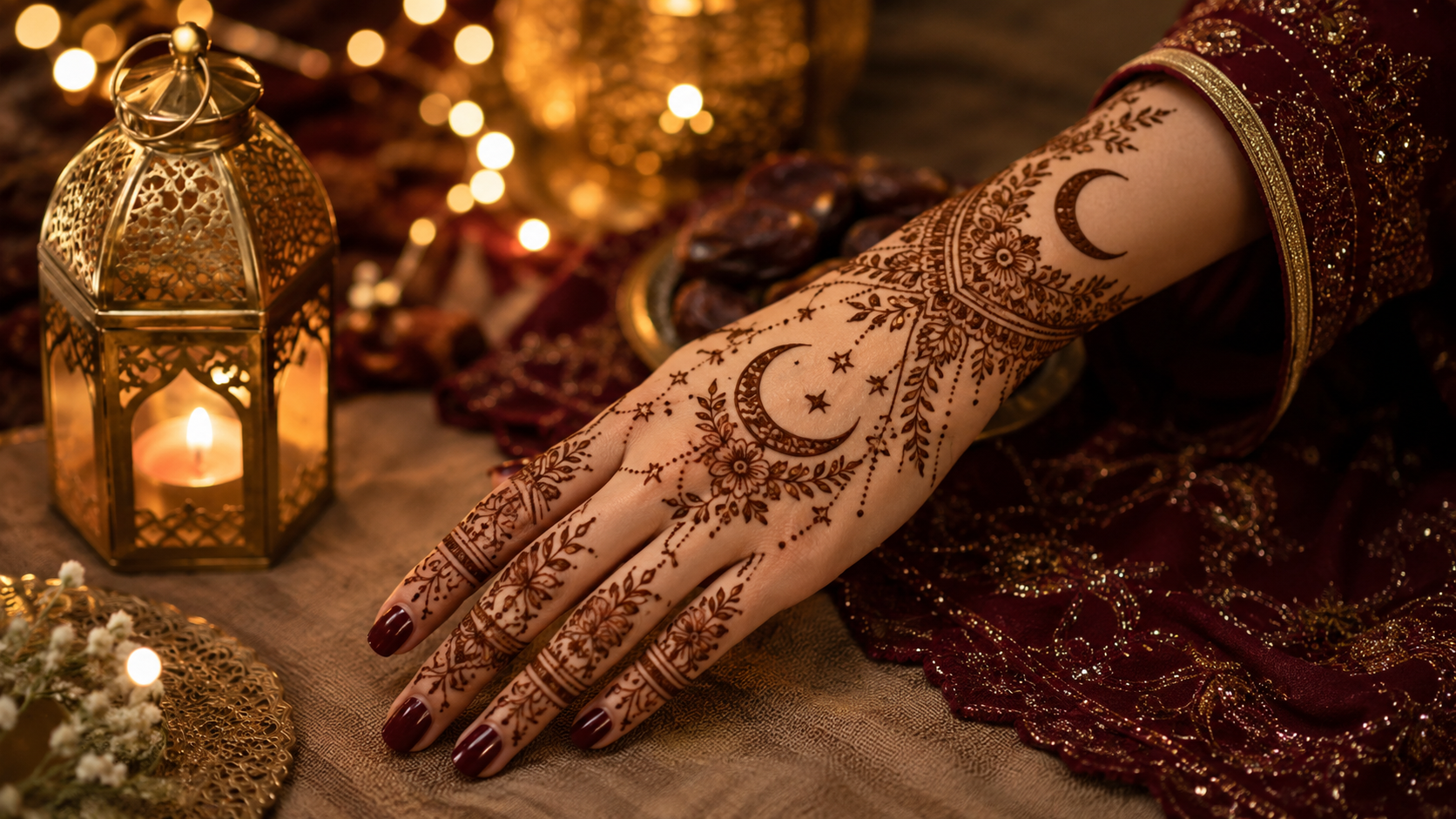
Ramadan evenings bring families together for prayer, iftar meals, reflection, charity, and time with loved ones. As Eid approaches, many families also enjoy preparing clothes, gifts, decorations, and festive mehndi.
Hand-drawn mehndi can look beautiful, but it takes practice and a steady hand. A stencil offers a simpler option. It can help beginners create balanced lines, clean shapes, and repeated patterns without drawing every detail from the beginning.
These Ramadan mehndi stencil ideas include crescent moons, lanterns, flowers, geometric patterns, wristbands, finger details, and child-friendly designs. You can use them for a family iftar, Ramadan gathering, Chaand Raat celebration, or Eid preparation.
For more information about festive stencil styles, materials, sizes, and design planning, visit our Mehndi & Festive Stencil Designs Complete Guide.
Why Use Mehndi Stencils During Ramadan?
A mehndi stencil is a prepared sheet or adhesive pattern with open areas that guide the placement of henna paste. Instead of drawing the complete design by hand, you apply the paste over or inside the open sections.
Stencils are useful because they can:
- Make detailed patterns easier for beginners.
- Reduce application time
- Keep both hands more balanced.
- Help create matching designs for family members.
- Provide neat outlines for later hand detailing.
- Support quick mehndi sessions during busy evenings.
- Allow the same theme to be repeated in several sizes.
Mehndi is a form of temporary skin decoration made with henna paste. Its designs and traditions vary across South Asia, the Middle East, North Africa, and other regions. It is commonly used for festive occasions, including Eid celebrations.
Current festive-design pages often highlight minimal patterns, Arabic trails, flowers, mandalas, wrist designs, back-hand styles, and crescent moon themes.
The best stencil is not always the most detailed one. It should match the available time, hand size, clothing style, and experience of the person applying it.
21 Ramadan Mehndi Stencil Ideas
1. Simple Crescent Moon Palm Stencil
A crescent moon is one of the most recognizable designs connected with Ramadan and Eid celebrations. It works especially well in the centre of the palm.
Choose a stencil with:
- One bold crescent
- A few small stars
- Tiny dots around the outside
- Enough open space around the main shape
A simple crescent design is a good choice for beginners because it does not require full-hand coverage. You can leave it alone for a minimal look or add small dots around the fingers.
Best for: Beginners, teenagers, short application sessions, and simple festive looks.
2. Crescent Moon and Floral Vine
This design combines a festive moon with a soft floral trail. Place the crescent near the wrist or lower palm, then allow the vine to move diagonally toward one finger.
The vine can include:
- Leaves
- Small flowers
- Curved stems
- Dots
- Teardrop shapes
The open space between the elements keeps the pattern light and modern. A diagonal arrangement also makes the hand appear longer without covering every area.
Best for: Front hands, back hands, young adults, and elegant outfits.
3. Ramadan Lantern Wrist Stencil
A lantern stencil creates a clear Ramadan theme without requiring a large design. Position one hanging lantern near the wrist and connect it to a dotted chain or curved line.
For a more decorative result, add:
- Small leaves around the lantern
- A thin bracelet border
- Stars above the lantern
- A second smaller lantern
- Hanging bead shapes
Keep the lantern outline bold enough for the stencil to hold its shape. Very narrow internal lines can tear or move during application.
Best for: Wrist designs, family gatherings, and medium-sized stencils.
4. Hanging Lantern Finger Trail
This design begins with a small lantern near the back of the hand. A line of dots or tiny stars then travels toward the middle finger.
It is less crowded than a full-hand pattern and works well when you want the jewellery and clothing to remain the main focus.
You can also place one small lantern on each hand for a matching pair.
Best for: Back hands, ring-focused styling, and quick evening application.
5. Mosque Silhouette Stencil
A simple mosque silhouette can create a strong festive design. The stencil may include one central dome, two small minarets, and a crescent above the roofline.
Avoid designs with too many tiny architectural details. A clean silhouette is easier to cut, position, and fill with henna.
For respectful use, choose decorative architecture rather than sacred writing. Avoid placing Qur’anic verses or sacred names on hands unless you have clear cultural and religious guidance.
Best for: Large palms, central back-hand designs, and bold festive themes.
6. Mosque Skyline Wrist Border
Instead of placing one large mosque in the centre of the hand, use a repeating skyline around the wrist.
The pattern can combine:
- Small domes
- Minarets
- Arches
- Stars
- Dotted borders
This creates a bracelet effect and leaves the palm open. It is also easier to match with rings, bangles, or a watch.
Best for: Wrist cuffs, simple palms, and modern festive styling.
7. Arabic Floral Trail Stencil
Arabic-style mehndi often uses flowing floral shapes, leafy vines, and open spaces. A stencil can begin near one side of the wrist and move diagonally across the hand.
Use one or two large flowers instead of filling the design with many small ones. Larger shapes are easier to apply and usually create a clearer stain.
A balanced Arabic trail may contain:
- One main flower
- Two smaller flowers
- Thick leaves
- Curved vines
- Dot clusters
- Open skin between sections
Arabic-inspired flowing designs continue to appear in festive mehndi coverage because they offer a full-looking result without covering the entire hand.
Best for: Eid outfits, long hands, and people who want a traditional but open design.
8. Minimal Flower and Moon Design
Place a small flower in the centre of the palm with a crescent shape beside it. Add only a few dots or leaves.
This design is useful when:
- You have limited time.
- You are applying mehndi yourself.
- You want a clean look.
- You prefer smaller stencils.
- You are testing a new henna cone.
A minimal design can still feel festive when the main shapes are well placed.
Best for: Beginners, working women, teenagers, and last-minute application.
9. Mandala Palm Stencil
A mandala-style design places a round, balanced motif in the centre of the palm. It can be simple or highly detailed depending on the stencil.
For Ramadan and Eid styling, combine the mandala with:
- Crescent-shaped outer petals
- Dotted rings
- Small stars
- Leaf borders
- Light finger details
Choose a mandala that fits the palm without reaching the finger joints. A stencil that is too large may bend or lift at the edges.
Best for: Front hands, symmetrical looks, and traditional clothing.
10. Half-Mandala Wrist Design
A half-mandala sits along the wrist like a decorative cuff. The top half opens toward the hand while the bottom edge forms a clean border.
This works well when a full circular mandala feels too formal or covers too much skin.
Complete the look with:
- One detailed finger
- Small dots along the hand
- A leaf trail
- A simple ring pattern
Best for: Bracelet-style designs and medium application times.
11. Islamic Geometric Pattern Stencil
Geometric stencils use repeated lines, stars, polygons, and connected shapes. They are a strong choice for people who prefer structured patterns instead of flowers.
Islamic geometric art includes complex arrangements built from repeated shapes and rosette-like forms. Stencil versions should simplify those patterns so the bridges remain strong and the henna can be applied cleanly.
For a hand stencil, use:
- One central star
- A repeated border
- Large connected shapes
- Clear negative space
- Thick support bridges
Avoid very small repeating sections unless the stencil is professionally cut.
Best for: Modern designs, back hands, and reusable stencils.
12. Star Border Finger Stencil
A narrow strip of stars and dots can be placed along one finger or across the base of several fingers.
This is one of the easiest Ramadan mehndi stencil ideas for people who do not want a full-hand design.
Try:
- One star on each finger
- A dotted line below the knuckles
- A small crescent on the middle finger
- Ring-style bands
- Alternating stars and leaves
Best for: Short sessions, young adults, and matching family designs.
13. Crescent Ring Mehndi Stencil
This design creates the appearance of a small ring around one finger. A tiny crescent or flower sits at the top, while a narrow band circles part of the finger.
Use a flexible adhesive stencil so the material stays close to the curved surface.
Do not apply too much paste. Thick paste can spread beyond the small openings and reduce detail.
Best for: Fingers, jewellery-inspired styles, and minimal looks.
14. Bracelet-Style Ramadan Stencil
A bracelet stencil wraps around the wrist with repeating flowers, crescents, arches, or geometric shapes.
It can be used alone or connected to a finger with one thin dotted chain.
Popular bracelet elements include:
- Scalloped borders
- Small crescent repeats
- Leaf rows
- Hanging beads
- Fine lattice patterns
- Lantern charms
Bracelet-style mehndi has remained popular in recent festive design coverage because it creates a polished look without requiring complete hand coverage.
Best for: Wrist-focused designs, bangles, and simple front hands.
15. Jewellery Chain Back-Hand Stencil
A jewellery-style pattern connects one finger to a wrist bracelet. The design resembles a hand chain worn with festive clothing.
Place:
- A flower or moon in the centre
- One line moving toward a finger.
- Two lines moving toward the wrist
- A narrow bracelet border
- Small dots between the main sections
Make sure the stencil is positioned while the hand is relaxed. If the fingers are stretched too far, the design may appear uneven when the hand returns to its normal position.
Best for: Back hands, formal Eid looks, and jewellery matching.
16. Negative-Space Crescent Stencil
In a negative-space design, the crescent remains as clear skin while henna fills the area around it.
This creates a bold shape without drawing the moon directly.
To make the crescent stand out:
- Use a darker filled background.
- Add a dotted outline.
- Keep nearby patterns simple.
- Avoid placing other large shapes too close.
- Use a stencil with clean, smooth edges.
Best for: Modern designs, photo-ready hands, and bold central motifs.
17. Moon Phases Finger Design
Use a sequence of moon shapes from a small crescent to a fuller circle. Place the shapes along one finger, the side of the hand, or across the wrist.
This idea feels modern while still matching the Ramadan moon theme.
Keep the phases simple. Small detailed textures inside the moons may not transfer clearly through a stencil.
Best for: Teenagers, modern outfits, and small adhesive stencils.
18. Palm Leaf and Date-Inspired Pattern
Ramadan gatherings often include dates at iftar, so a palm-leaf-inspired design can provide a subtle seasonal connection without using words or detailed pictures of food.
Build the stencil around:
- Long curved leaves
- Small oval shapes
- Dotted stems
- One crescent accent
- Open spaces between branches
This design looks natural and works well on the side of the hand or wrist.
Best for: Nature-inspired patterns and people who do not want common floral designs.
19. Small Ramadan Mehndi Stencils for Kids
Children often prefer fast, simple designs. Choose one small stencil instead of covering the entire hand.
Good child-friendly ideas include:
- One crescent
- Three stars
- A small flower
- A simple lantern
- A heart and moon combination
- A dotted bracelet
- One decorated finger
Keep the session short and allow the child to choose the design. Use a product with clearly listed ingredients and follow its safety instructions.
Avoid products sold as “black henna.” Research has linked some black temporary henna products containing PPD with serious allergic skin reactions and future sensitivity.
Best for: Family gatherings, supervised activities, and small hands.
20. Matching Mother-and-Daughter Stencils
Choose one main motif and prepare it in two sizes. For example, use a larger crescent and flower for an adult hand and a smaller crescent for a child.
Matching designs may include:
- Two lanterns in different sizes
- Matching wristbands
- One large and one small mandala
- Similar finger stars
- The same floral trail with fewer details for the child
The designs do not need to be identical. Repeating one clear feature is enough to make them feel connected.
Best for: Family photos, Chaand Raat, and Eid preparation.
21. Full-Hand Ramadan Celebration Stencil
A full-hand stencil can combine several ideas into one complete layout.
A balanced full-hand design might include:
- A mandala or crescent in the palm
- A floral vine moving toward the fingers.
- Small lanterns near the wrist
- Geometric borders around open areas
- Different details on each finger
- A bracelet-style ending
Do not place every Ramadan symbol in one design. Choose two main ideas and use dots, leaves, and lines as supporting details.
For example, combine a crescent with flowers or lanterns with a geometric border. This creates a clear theme without making the hand look crowded.
Best for: Experienced users, professional artists, Eid events, and longer application sessions.
How Do You Choose the Right Ramadan Mehndi Stencil?
Consider the Available Time
For a quick design, choose:
- One palm motif
- A wrist bracelet
- One decorated finger
- A small back-hand flower
- A crescent and stars
For a longer session, choose:
- A full Arabic trail
- A mandala with finger details
- A jewellery-style pattern
- A full-hand combination
- Matching front- and back-hand stencils
Match the Stencil to the Hand Size
Measure the usable area before printing or cutting a stencil.
Check:
- Palm width
- Wrist width
- Finger length
- Distance from wrist to knuckles
- Position of natural hand folds
A design that looks balanced on a large adult hand may cover too much of a teenager’s or child’s hand.
Choose the Right Detail Level
Beginners should start with:
- Bold outlines
- Large openings
- Fewer bridges
- Clear spaces
- One central motif
Experienced users can try:
- Fine flowers
- Layered borders
- Detailed lattices
- Multiple stencil sections
- Small finger patterns
Match the Design to the Outfit
A simple design may work better with heavily decorated clothing. A fuller mehndi pattern can add detail when the outfit is plain.
You can also repeat one clothing element in the stencil, such as:
- A flower from the fabric
- A geometric border
- A jewellery shape
- A curved embroidery line
- A small star pattern
How to Apply a Ramadan Mehndi Stencil Step by Step
Step 1: Prepare the Skin For the full process, follow our guide to applying mehndi stencils at home.
Wash the area and dry it completely. Avoid applying heavy cream or oil immediately before positioning the stencil because this may prevent it from sticking properly.
Step 2: Check the Stencil Size
Place the stencil over the hand before removing any adhesive backing. Confirm that the main shape sits in the correct position.
Step 3: Secure the Stencil
Press the stencil gently from the centre toward the edges. Pay special attention to small shapes and bridges.
For reusable non-adhesive stencils, hold the sheet firmly or use skin-safe tape where suitable.
Step 4: Apply the Henna Paste
Apply a controlled layer of paste through the openings. Do not press so hard that the paste moves under the stencil.
Begin with larger sections, then fill the smaller details.
Step 5: Lift the Stencil Carefully
Lift one edge slowly while keeping the hand still. Pull the stencil away in one direction instead of dropping it back onto the wet design.
Step 6: Correct Small Gaps
Use a fine henna cone to connect broken lines, add dots, or improve the edge of a flower.
This combination of stencil work and simple hand detailing often looks more natural than relying on the stencil alone.
Step 7: Follow the Henna Instructions
Allow the paste to dry and follow the directions supplied with the product. Natural henna normally begins with an orange stain and develops into a deeper reddish-brown shade as it oxidizes.
How Can You Stop Henna from Bleeding Under a Stencil?
Henna usually spreads under a stencil when the material is loose or too much paste is applied.
To reduce bleeding:
- Clean and dry the skin first
- Use the correct stencil size.
- Press all edges firmly.
- Keep the hand relaxed and still.
- Apply paste in a controlled layer.
- Avoid dragging the cone across loose sections.
- Lift the stencil before the paste becomes stuck to it.
- Practise on paper or a practice hand first.
If one section repeatedly bleeds, the opening may be too small, or the stencil bridge may be too weak.
Common Ramadan Mehndi Stencil Mistakes
Choosing a Design That Is Too Large
An oversized stencil may fold around the palm or extend over finger joints. Resize the design before cutting or printing it.
Using Too Many Tiny Details
Very small openings can trap paste or fail to transfer. Simplify the design and keep the main shapes clear.
Moving the Hand During Application
Ask the person to rest the hand on a flat surface. Avoid applying a detailed stencil while the hand is held in the air.
Applying Paste Too Thickly
More paste does not always produce a better design. A heavy layer can move under the edges and join separate shapes together.
Removing the Stencil Too Quickly
Fast removal can smear wet sections. Lift slowly from one side while keeping the stencil away from the completed pattern.
Reusing a Damaged Adhesive Stencil
A stretched or torn stencil may no longer sit flat. Replace it rather than risking a blurred design.
Using Unlabelled Black Henna
Avoid products with unclear ingredient lists or products that promise an immediate jet-black skin stain. Some products marketed as black henna may contain PPD, which can cause serious skin reactions.
Practical Ramadan Mehndi Stencil Use Cases
Family Iftar Gathering
Choose small designs that can be applied quickly to several people. Crescent, flower, star, and bracelet stencils work well.
Chaand Raat Preparation
Use more detailed Arabic trails, lanterns, full-hand stencils, and matching family designs when there is more time before Eid.
Beginner Practice Session
Start with cardstock practice sheets or a printed hand outline. Practise applying paste through the stencil before using it on skin.
Home Mehndi Artist
Prepare each design in small, medium, and large sizes. Organize stencils by placement, such as palm, wrist, finger, front hand, and back hand.
Children’s Activity
Offer a small selection of simple shapes. Keep the activity supervised, check product ingredients, and avoid long application sessions.
Frequently Asked Questions
What are the easiest Ramadan mehndi stencil ideas for beginners?
The easiest choices are a crescent moon, small lantern, single flower, star finger border, or simple wrist bracelet. These designs use larger openings and fewer fine details.
Which stencil is best for the front of the hand?
Mandala, crescent moon, floral palm, and diagonal Arabic designs work well on the front of the hand. Choose a size that stays clear of deep palm folds.
Which stencil looks best on the back of the hand?
Jewellery-chain designs, floral trails, lantern motifs, and geometric patterns look attractive on the back of the hand because the surface is relatively open and visible.
Can children use Ramadan mehndi stencils?
Small, simple stencils can be used for children with adult supervision. Check the complete ingredient list and avoid black henna or products with unclear contents.
Can one stencil be used on both hands?
A reusable stencil may be flipped when the design and material allow it. Adhesive stencils may not attach correctly after the first use, so prepare a mirrored pair for balanced hands.
Should both hands have the same design?
No. You can use the same main motif with different supporting details. For example, place a crescent on one hand and a lantern on the other while using matching floral borders.
How can I make a Ramadan stencil look more original?
Combine two related elements instead of using a single ready-made pattern. Add hand-drawn dots, leaves, finger bands, or borders after lifting the stencil.
Learn More and References
- Wikipedia: Ramadan: A general definition and overview of Ramadan, its place in the Islamic calendar, and its focus on fasting, prayer, reflection, and community.
- Wikipedia: Mehndi A general introduction to mehndi as temporary henna body art and its use across different regions and celebrations.
- Medical research on temporary black henna and PPD reactions: An academic review describing allergic reactions linked to PPD in products marketed as black henna.
Conclusion
Ramadan mehndi stencils make it easier to create clean and festive designs without advanced drawing skills. Beginners can start with small crescents, lanterns, flowers, finger borders, and wrist bracelets. More experienced users can combine mandalas, Arabic trails, geometric shapes, and jewellery-style patterns.
Choose a stencil that fits the hand, the time available, and the desired level of detail. Keep sacred text out of casual body designs unless you have proper cultural guidance, use clearly labelled henna products, and avoid unlabelled black henna.
The strongest design is not always the one with the most detail. A well-positioned crescent, flower, or lantern can look more polished than an overcrowded full-hand pattern.