Calculate your stencil project
Estimate paint required for repeated craft motifs rather than the entire wall surface.
Enter your values and calculate.
How to use the Stencil Paint Coverage Estimator
The free stencil paint coverage estimator calculates paint volume for repeated stencil motifs, not the paint needed for an entire wall. Enter motif size, the percentage of the design that receives color, number of repeats, coats, and the spreading rate of your paint. Add a waste allowance for leftover paint and test impressions. Results appear in US fluid ounces and milliliters. This is a planning estimate rather than a purchasing guarantee.
Enter seven paint-specific inputs
- Motif width: Outer design width in inches.
- Motif height: Outer design height in inches.
- Painted fraction: Percentage of the motif rectangle exposed through openings.
- Repeats: Number of separate motif impressions.
- Coats: Number of painting passes per impression.
- Coverage rate: Square feet covered by one US fluid ounce.
- Waste: Extra percentage for tests, tools, and touch-ups.
Press Calculate to see effective painted coverage and the estimated paint volume including waste. Changing an input recalculates the result. Measurements use inches and coverage uses square feet per fluid ounce. The estimator does not inspect or measure artwork uploaded elsewhere.
Painted motif area versus whole wall coverage
A stencil's surrounding rectangle includes both solid mask and painted openings. Only the openings contribute to color coverage. A 45% open motif paints less than half of its bounding rectangle, regardless of how large the wall is. That makes motif paint estimates different from ordinary room painting calculators. For painting a complete background wall, Benjamin Moore's official paint calculator explains whole-surface estimates and application variables.
Stencil paint coverage formula
Calculate one motif's rectangle in square feet: width × height ÷ 144. Multiply by painted fraction ÷ 100 to count only the openings. Then multiply by the number of repeats and coats. This gives the effective painted coverage across every pass. Divide that area by the paint's coverage rate (square feet per fluid ounce). Multiply the result by (1 + waste allowance ÷ 100). For milliliters, multiply fluid ounces by approximately 29.5735.
Worked example: 24 stencil impressions
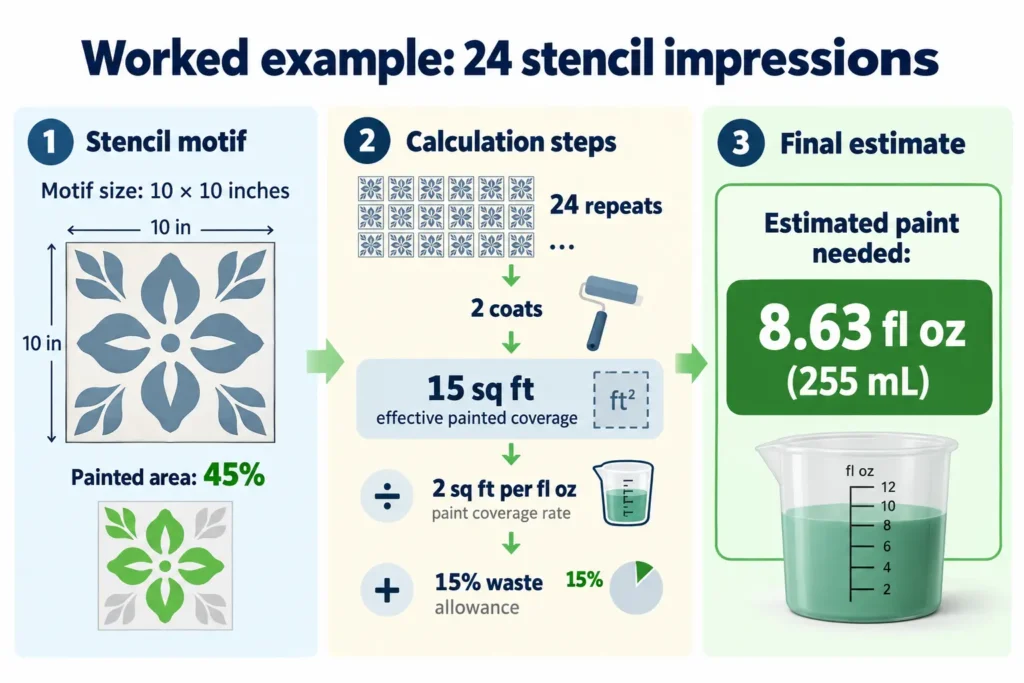
Suppose each stencil is 10 × 10 inches, 45% open, and repeated 24 times with two coats. Each outer rectangle measures 100 ÷ 144 = 0.6944 square feet. Its painted portion is 0.3125 square feet. Twenty-four impressions cover 7.50 square feet per coat; two coats require 15.00 square feet of effective painted coverage. With a spreading rate of 2 square feet per fluid ounce, you need 7.50 fl oz before waste. Add 15% and the estimate becomes 8.63 fl oz (255 mL). These are the calculator's default inputs.
Estimate the painted fraction of a stencil
The painted fraction describes how much of a design's outer rectangle is open. Delicate outlines expose less area than bold letters or dense geometric shapes. For a simple estimate, overlay a square grid and compare open squares with the complete rectangle. A vector editor can offer more accurate open-area measurements. Enter 25% if roughly one-quarter of the bounding rectangle will be painted. This is not the percentage of the entire wall covered by repeating motifs.
How paint coats affect the estimate
Coats count repeated painting passes through the same openings. Two coats approximately double the calculated paint demand compared with one; they do not double the physical size of the stencil or wall. Coverage depends on opacity, surface color, and technique. Try a test impression and follow manufacturer drying instructions. Applying one excessively heavy coat can cause paint to bleed under stencil edges.
Surface texture, paint tools, and absorption
Porous wood, fabric, rough plaster, canvas, and sealed surfaces may use different amounts of paint. Foam rollers, sponge brushes, and sprayers transfer paint differently. Enter a spreading rate suited to the particular coating and method rather than assuming that all products perform alike. Sherwin-Williams offers application guidance for rollers and surfaces. A small test on matching material is useful when the exact rate is unknown.
Allow for paint waste and test impressions
Not every drop reaches the finished design. Paint can stay on applicators, in trays, on masking, or on rejected test pieces. The waste field adds a percentage after all repeats and coats have been counted. Enter zero for a theoretical baseline or increase the allowance using experience from similar projects. Waste here refers to paint volume, not the cost of stencil material or unused cutout sheets.
Paint quantity is different from cost and layout
This page answers how much paint do I need for repeated stencil patterns? It does not calculate sheet yield, spacing between wall motifs, print resolution, or production prices. To estimate sheet purchases, adhesive, and labor, use our Stencil Material Cost Calculator. To prepare stencil artwork, use the Stencil Maker. Each calculator addresses a different stage of the same craft workflow.
Frequently asked questions
Does this estimate paint for an entire wall?
No. It estimates paint through repeated cutout openings. A solid background coat requires a separate whole-surface calculation.
Can I include a second paint coat?
Yes. Enter 2 for Coats. The tool counts the same painted motif twice when calculating the required volume.
Where can I find paint coverage per fluid ounce?
Check the manufacturer's product label or data sheet and convert its spreading rate to square feet per US fluid ounce.
Can the waste allowance be zero?
Yes. Zero gives a theoretical estimate before losses from applicators, test prints, or spills.
Will the actual amount always match?
No. Surface porosity, paint thickness, and application technique can change real consumption.