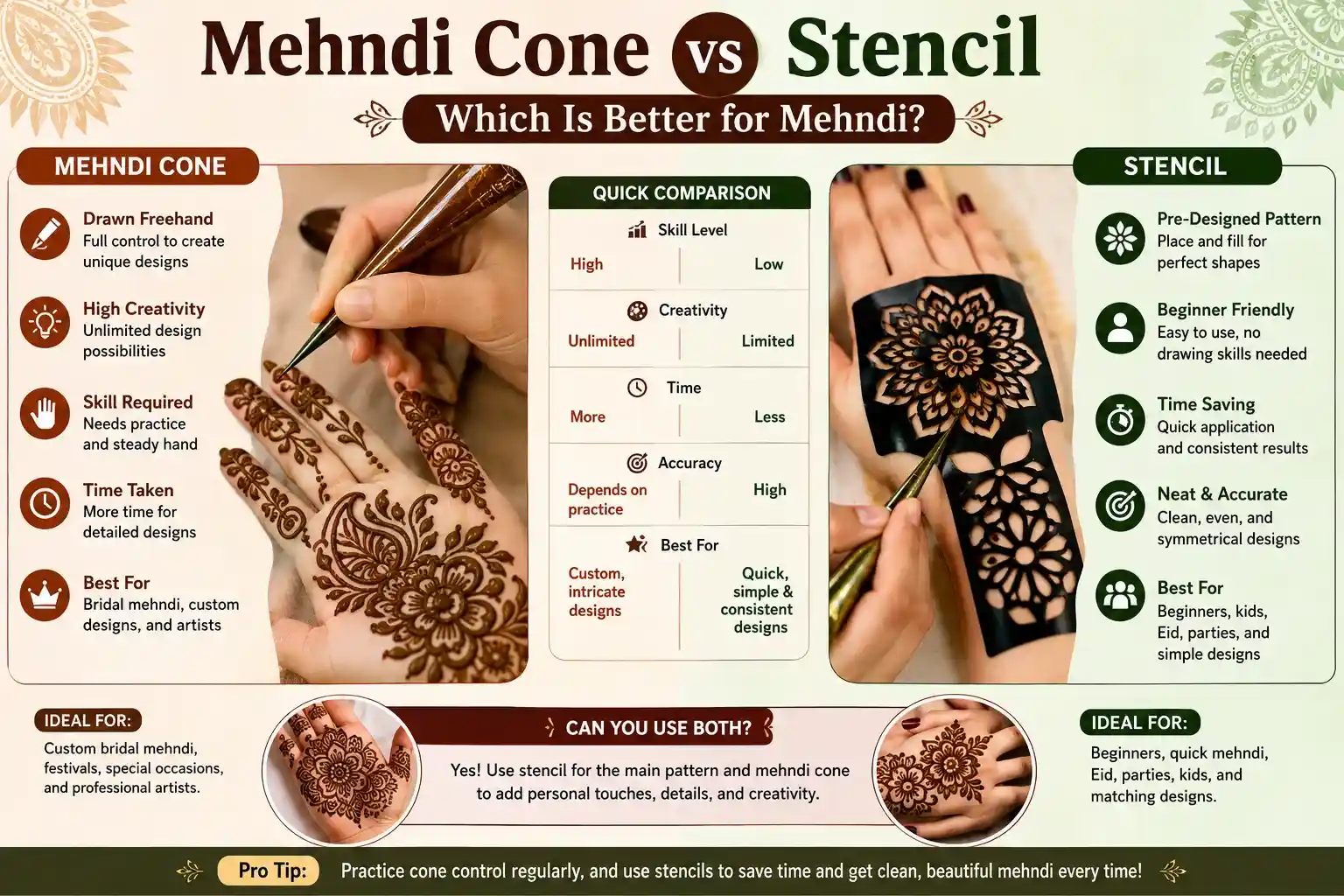
Choosing between a mehndi cone and a mehndi stencil can be confusing, especially when you want a beautiful design but do not have much practice with freehand mehndi. The two methods are not actually direct replacements for one another: a cone is the application tool, while a stencil is a pattern-guiding template. In many cases, you can use both together.
A mehndi cone gives you direct control over the paste, line thickness, curves, dots, paisleys, flowers, and other design elements. A stencil, on the other hand, gives you a predefined structure that can help reproduce an intricate pattern with less drawing experience.
That distinction is important because many beginner comparison articles treat “cone versus stencil” as though you must choose only one. In reality, the better question is: Which method gives you the right balance of speed, creativity, precision, and learning for your particular occasion?
Mehndi is traditionally a temporary form of skin decoration using henna, particularly associated with South Asian traditions including Pakistan and India.
For a broader foundation, see the Mehndi & Festive Stencil Designs Complete Guide, which serves as the main pillar for this Mehndi and Festive Stencil silo.
Mehndi Cone vs Stencil at a Glance
| Feature | Mehndi Cone | Mehndi Stencil |
| Beginner friendly | Moderate | High |
| Drawing skill required | Yes | Low |
| Speed | Depends on skill | Usually faster for fixed patterns |
| Creative freedom | Excellent | Limited to template |
| Design consistency | Depends on hand control | High for the same template |
| Customization | Excellent | Limited unless creating your own stencil |
| Detailed patterns | Excellent with practice | Excellent for predefined patterns |
| Learning value | Very high | Moderate |
| Repeating the same design | Requires practice | Very easy |
| Matching both hands | More difficult | Easier |
| Best for | Artists and learners | Beginners and quick applications |
| Main tool | Henna cone | Stencil + henna cone |
| Can they be combined? | Yes | Yes |
The most important point is that a stencil usually still needs a cone or another applicator to put the mehndi paste through its openings. Current henna tutorials describe stencil use as placing the template on the skin and applying henna through the cut areas, often with a cone.
What Is a Mehndi Cone?
A mehndi cone is a small applicator filled with henna paste. Pressure on the cone pushes paste through the narrow opening at its tip.
The artist controls the result by changing:
- Hand pressure
- Cone angle
- Movement speed
- Tip opening
- Distance between the tip and skin
- Amount of paste released
A cone therefore behaves more like a drawing instrument than a template.
With enough practice, you can use one cone to create almost an unlimited combination of lines, dots, petals, vines, paisleys, borders, grids, and freehand compositions.
Modern beginner guides similarly emphasize that cone control influences line width and consistency, while practice improves the ability to produce controlled strokes.
Main advantage of a mehndi cone
The biggest advantage is creative control.
You are not restricted to one design. You can create the design while you work.
That makes the cone particularly useful for:
- Personalized bridal mehndi
- Custom names and initials
- Arabic-style compositions
- Traditional motifs
- Freehand floral patterns
- Finger patterns
- Custom spacing
- Last-minute design changes
- Artistic experimentation
Main disadvantage of a mehndi cone
The cone has a learning curve.
A beginner may struggle with:
- Uneven lines
- Excess paste
- Broken lines
- Shaky curves
- Uneven dots
- Inconsistent pressure
- Symmetry
- Matching both hands
This does not mean the cone is difficult forever. It means that the cone rewards practice.
What Is a Mehndi Stencil?
A mehndi stencil is a pre-cut template containing openings that represent a design. You position the template over the intended area and apply mehndi through those openings.
Stencil-based application is popular because it gives beginners a visual structure to follow instead of requiring them to draw every design element manually. Current beginner-oriented stencil guides commonly emphasize speed, ease of use, and reduced drawing requirements.
Some stencils are reusable sheets, while others are adhesive-style templates. Designs may include:
- Mandalas
- Flowers
- Paisleys
- Arabic patterns
- Finger designs
- Wrist bracelets
- Floral vines
- Bridal motifs
- Geometric patterns
- Festival-inspired patterns
Main advantage of a mehndi stencil
The biggest advantage is structure.
You already have the overall composition. Instead of wondering where the next flower, curve, or paisley should go, the stencil provides the layout.
This is especially useful for someone applying mehndi for the first time.
Main disadvantage of a mehndi stencil
The trade-off is creative freedom.
A stencil gives you the design it was created to reproduce. Unless you modify or create your own template, you cannot easily make every part unique.
There can also be practical limitations with adhesive sticker-style stencils and traditional natural henna. One specialist henna tutorial points out that traditional sticker stencils can be problematic when the paste needs to remain on the skin for a longer stain-development period, while stencil paper can offer more flexibility for natural henna work.
That is an important gap that many beginner comparison pages do not explain.
Mehndi Cone vs Stencil: The Biggest Difference
The simplest way to understand the difference is this:
A cone creates the design. A stencil guides the design.
A cone asks:
“Can you control the paste and draw the pattern?”
A stencil asks:
“Can you position the template correctly and apply the paste cleanly?”
This makes them useful for different skill levels.
A person who wants to learn mehndi drawing should spend more time practicing with the cone.
Someone who wants a quick, repeatable pattern may prefer a stencil.
Someone who wants both speed and customization can use a hybrid approach: use a stencil for the main composition, then use the cone to add dots, borders, small leaves, personalization, or connecting elements.
Which Is Better for Beginners?
Stencil Is Usually Easier for First-Time Users
For a beginner with little or no drawing experience, a stencil generally provides a quicker route to a recognizable pattern.
You do not have to solve the entire composition yourself. The stencil already establishes the major shapes.
That can reduce frustration during:
- Eid preparation
- Family gatherings
- School events
- Mehndi nights
- Casual parties
- Children’s activities
- Last-minute festive applications
Digitalonday’s existing beginner stencil guidance similarly identifies beginner friendliness, speed, and consistency as major stencil advantages.
However, beginners should not interpret “easier” as “automatically perfect.”
You still need to control:
- Paste quantity
- Pressure
- Stencil placement
- Edge contact
- Removal technique
- Drying time
A poorly positioned stencil can still produce a messy design.
Which Is Better for Learning Mehndi?
The Cone Wins for Skill Development
A stencil can give you an attractive result without requiring advanced freehand skills. But it does not teach every underlying skill needed for freehand mehndi.
Working with a cone teaches:
- Pressure control
- Line consistency
- Curvature
- Spacing
- Symmetry
- Pattern repetition
- Hand stability
- Design composition
- Visual balance
Many beginner learning resources recommend practicing basic lines, dots, curves, petals, and simple shapes before attempting advanced designs.
A good learning strategy is therefore:
Stencil for confidence + cone practice for skill.
You do not need to reject stencils because you want to become a better mehndi artist. Use them as training references. Trace or study the structure of a stencil design, then try recreating selected sections freehand.
Which Is Faster: Mehndi Cone or Stencil?
Stencil Usually Wins for Fixed Designs
Suppose you have five people who all want a similar floral design.
With freehand cone application, every person requires a new drawing.
With a stencil, you can reproduce the main design repeatedly.
This is particularly useful for:
- Bridesmaids
- Guests
- Children
- Family groups
- Party activities
- Festival booths
- Quick event applications
For one unique custom design, however, a skilled cone artist may actually be faster than positioning a complicated stencil.
So the answer depends on the situation:
One custom design + skilled artist = cone can be faster.
Several matching designs + beginner = stencil is usually faster.
Which Gives Better Creative Freedom?
Mehndi Cone Wins
A cone has almost no predefined design boundary.
You can begin with a flower, extend it into a vine, add a paisley, change the spacing, create negative space, add initials, and adapt the design around the natural shape of the hand.
A stencil cannot easily do this unless the stencil itself has been custom-designed.
This matters especially for bridal work, where the design often needs to flow across:
- Fingers
- Palm
- Wrist
- Forearm
- Side of hand
The cone allows the artist to react to the available space.
Which Gives Better Symmetry?
Stencil Usually Wins for Beginners
Symmetry is one of the hardest parts of freehand mehndi.
Even a good beginner may draw one flower slightly larger than the other. A stencil reduces this issue because the same template establishes the same basic shape.
This does not mean a stencil automatically produces perfect symmetry. Placement still matters.
For matching designs on both hands, use alignment carefully and avoid assuming that the hands are identical in shape.
Which Is Better for Bridal Mehndi?
It Depends on the Bridal Design
For highly customized bridal mehndi, a skilled cone artist usually has the advantage.
Bridal designs often need adaptation to:
- Hand shape
- Finger length
- Outfit
- Event style
- Personal symbolism
- Names or initials
- Desired coverage
- Available time
A stencil can be useful for a bridal-inspired motif, but relying entirely on a fixed template may make the final design look repetitive.
A practical compromise is to use a stencil for a major motif and then customize the surrounding area with a cone.
For example:
Stencil: Central mandala
Cone: Finger lines, leaves, dots, vines, initials, borders, and connecting patterns
This produces a more personalized result without requiring the artist to draw the entire central pattern from scratch.
Which Is Better for Eid Mehndi?
Stencils Are Excellent for Quick Eid Designs
Eid often means applying mehndi to several people in a short period.
A stencil can be helpful when you want:
- Simple floral patterns
- Arabic motifs
- Finger designs
- Wrist designs
- Small mandalas
- Matching family designs
- Fast decorative patterns
For larger family gatherings, repeatability becomes a major advantage.
A stencil also lets a beginner participate without needing years of drawing practice.
Can You Use a Mehndi Cone With a Stencil?
Yes — This Is Often the Best Combination
This is the most important practical answer in the entire comparison.
You do not necessarily have to choose between a cone and stencil.
You can use:
Stencil + Mehndi Cone = Guided Application
The stencil establishes the design and the cone supplies the paste.
A typical workflow is:
Step 1: Prepare the skin
Clean and dry the intended area. Avoid applying oily products immediately before stencil placement because they can interfere with adhesion or positioning.
Step 2: Position the stencil
Place the design carefully and check orientation before applying paste.
Step 3: Secure the stencil
Make sure detailed edges are making adequate contact with the skin.
Step 4: Test the cone
Create a short line on paper or another suitable practice surface first. Check whether the paste flows smoothly.
Step 5: Apply controlled amounts
Use the cone to fill the stencil openings without flooding them.
Step 6: Check small details
Make sure the paste reaches the intended openings without spreading across neighboring areas.
Step 7: Remove carefully
Follow the stencil material’s intended removal method and avoid dragging the design.
Step 8: Add freehand details
After the main structure is established, a cone can add personalized elements around the stencil design.
This hybrid approach combines the main advantage of each method: stencil consistency plus cone creativity.
When Should You Choose a Mehndi Cone?
Choose a cone when:
- You want a completely custom design.
- You want to learn freehand mehndi.
- You are comfortable controlling paste flow.
- You want to personalize every section.
- You are creating bridal mehndi.
- You need to adapt the design to unusual hand shapes.
- You enjoy drawing and experimenting.
- You want to create original patterns rather than repeat templates.
A cone is also the better long-term investment for someone serious about becoming a mehndi artist because repeated practice develops transferable skills.
When Should You Choose a Mehndi Stencil?
Choose a stencil when:
- You are completely new to mehndi.
- You need a quick design.
- You want consistent results.
- You are applying similar designs to several people.
- You need an attractive pattern without advanced drawing skills.
- You are preparing for Eid or another festive event.
- You want to practice design placement.
- You need a repeatable motif.
A stencil is not a shortcut that eliminates technique. It is a tool that moves some of the design-planning work from your hand onto a prepared template.
Mehndi Cone vs Stencil for Different Situations
| Situation | Better Choice | Why |
| First-time mehndi | Stencil | Easier starting structure |
| Learning freehand | Cone | Builds drawing control |
| Eid family event | Stencil | Faster repeatable designs |
| Bridal customization | Cone | Maximum flexibility |
| Matching guest designs | Stencil | Consistent composition |
| Creative experimentation | Cone | Unlimited design freedom |
| Quick finger designs | Stencil | Fast placement |
| Personalized initials | Cone | Easy customization |
| Teaching children | Stencil | Lower initial difficulty |
| Advanced artist | Cone | Better artistic control |
| Large repeated pattern | Stencil | Consistent positioning |
| Hybrid modern design | Both | Best balance of structure and creativity |
Common Problems With Mehndi Stencils
Stencils can reduce drawing mistakes, but they introduce their own problems.
Stencil Moves During Application
If the template shifts, the design can become blurry or doubled.
Fix: secure the stencil carefully and reduce sideways pressure during application.
Too Much Mehndi Paste
Excess paste can spread across the stencil openings.
Fix: use controlled cone pressure and fill openings gradually.
Poor Stencil Contact
Gaps around the stencil can allow paste to spread beyond the intended design.
Fix: smooth the stencil and pay extra attention to intricate edges.
Design Is Too Detailed
Extremely small openings can be difficult to fill cleanly.
Fix: choose a simpler stencil or use a design with larger negative spaces.
Sticker-Style Stencil Does Not Suit the Henna Process
Not every stencil material is appropriate for every type of henna application. A specialist henna resource notes that traditional adhesive stencils can conflict with the longer development period associated with natural henna, while stencil paper may be more adaptable.
Always follow the instructions for the specific stencil material and henna product rather than assuming every stencil works identically.
Common Problems With Mehndi Cones
Uneven Lines
Usually caused by inconsistent pressure or movement speed.
Fix: practice straight lines and curves before starting the actual design.
Cone Tip Is Too Large
A large opening releases too much paste.
Fix: use a suitable fine tip or prepare the cone correctly according to its construction.
Paste Stops Flowing
Possible causes include a blocked tip or inconsistent paste texture.
Fix: check and clear the tip carefully before continuing.
Shaky Design
Beginners often grip the cone too tightly.
Fix: relax your hand and practice controlled movements.
Smudging
The application hand or another object can accidentally touch wet paste.
Fix: plan the direction of your design and keep completed areas protected.
Are Mehndi Stencils Better Than Freehand Mehndi?
Not universally.
They are better for speed, consistency, and beginner accessibility.
Freehand cone application is better for creativity, personalization, and advanced artistic control.
The winner depends on your objective.
A useful way to decide is:
Need a design quickly? Choose a stencil.
Want to learn the art? Practice with a cone.
Want both speed and personalization? Use both.
Is a Stencil Good for Learning Freehand Mehndi?
Yes, when used correctly.
The mistake is treating the stencil as a replacement for practice.
Instead, use a stencil as a visual study tool.
Look at:
- How flowers connect
- How much negative space is used
- How finger patterns relate to the palm
- How paisleys balance one another
- How borders frame a central motif
- How dots fill empty areas
Then recreate individual components using your cone.
For example, after applying a floral stencil, practice drawing the same flower separately on paper. Then draw it without looking at the stencil.
This transforms a ready-made template into a structured learning exercise.
What About Custom Mehndi Stencils?
Custom stencils provide a third option between completely freehand work and ready-made patterns.
You can create a stencil based on:
- Your own sketch
- A digital illustration
- A floral arrangement
- A logo or symbol
- A personalized name
- A festival motif
- A geometric pattern
Digital design tools can be useful for planning custom artwork before converting it into a physical template. Canva, for example, provides design workflows and templates relevant to festive and Mehndi-related visual projects.
This approach is particularly useful when you want a design that is repeatable but still personal.
Mehndi Cone vs Stencil: The Final Verdict
There is no single winner because the two tools solve different problems.
Choose a Mehndi Cone If:
You want creative freedom, custom designs, advanced bridal work, or long-term artistic development.
Choose a Mehndi Stencil If:
You want a quick, consistent, beginner-friendly design without having to draw every detail manually.
Choose Both If:
You want the fastest path to a structured design while keeping the ability to add personal freehand details.
For most beginners, starting with a simple stencil plus a good-quality cone is a practical introduction. As confidence improves, gradually replace parts of the stencil pattern with freehand work.
That progression can look like:
Stencil → Trace → Modify → Combine → Freehand
Eventually, the stencil becomes a reference rather than a dependency.
People Also Ask About Mehndi Cone vs Stencil
Is mehndi stencil better than a cone?
A stencil is easier for beginners and faster for repeatable patterns, while a cone provides much greater creative control. In practice, they are often used together.
Can you apply mehndi with a stencil?
Yes. Many stencil workflows involve placing a template on the skin and applying henna through its openings using a cone or applicator.
Are mehndi stencils good for beginners?
Yes, particularly for people who want a recognizable design without first mastering freehand drawing.
Can a stencil make bridal mehndi?
It can create bridal-inspired motifs, but fully customized bridal mehndi generally benefits from freehand cone work.
Do professional mehndi artists use stencils?
Some artists may use templates or references for specific designs, but professional work often relies heavily on freehand control and customization. The appropriate method depends on the artist and project.
Can I use a stencil to learn mehndi?
Yes. Use the stencil to study composition and then practice individual elements with a cone.
Which is faster for Eid mehndi?
A stencil is generally faster when the same or similar design needs to be applied repeatedly.
Can I personalize a stencil design?
Yes. Apply the main stencil pattern first, then use the cone to add initials, dots, leaves, borders, vines, or other custom elements.
Practical Recommendation for Beginners
If this is your first time applying mehndi, do not force yourself to choose between “artist” and “stencil user.”
Start with a simple stencil to understand:
- Placement
- Composition
- Negative space
- Pattern scale
- Hand positioning
- Paste control
Then use your cone separately for practice.
Practice basic:
- Lines
- Dots
- Curves
- Leaves
- Petals
- Paisleys
- Small flowers
Once those elements become comfortable, begin modifying stencil patterns.
This gives you a gradual route from guided designs to independent artwork.
The goal should not be to avoid stencils forever. The goal should be to understand why the stencil works, so eventually you can create the same structure yourself.
Final Takeaway
The mehndi cone vs stencil debate becomes much easier once you understand that they are not truly competing tools.
The cone gives you control.
The stencil gives you structure.
The cone is better for creativity, customization, and developing freehand skill. The stencil is better for speed, repeatability, and helping beginners produce structured designs.
For Eid, parties, family gatherings, and quick beginner applications, a stencil can be extremely practical. For bridal work, custom designs, and long-term artistic development, cone practice becomes increasingly important.
The most flexible option is to combine the two: use a stencil for the main pattern and a cone for personalization.
That hybrid approach gives beginners confidence without preventing them from developing real mehndi skills.
For more beginner patterns and practical application guidance, continue with Simple Mehndi Stencils for Beginners and then return to the main Mehndi & Festive Stencil Designs Complete Guide for the complete silo.
References
Mehndi and Henna Background: Wikipedia — Mehndi overview
These references are included because they support the definitions, cone-control workflow, and stencil-application explanation rather than being added purely for link quantity.