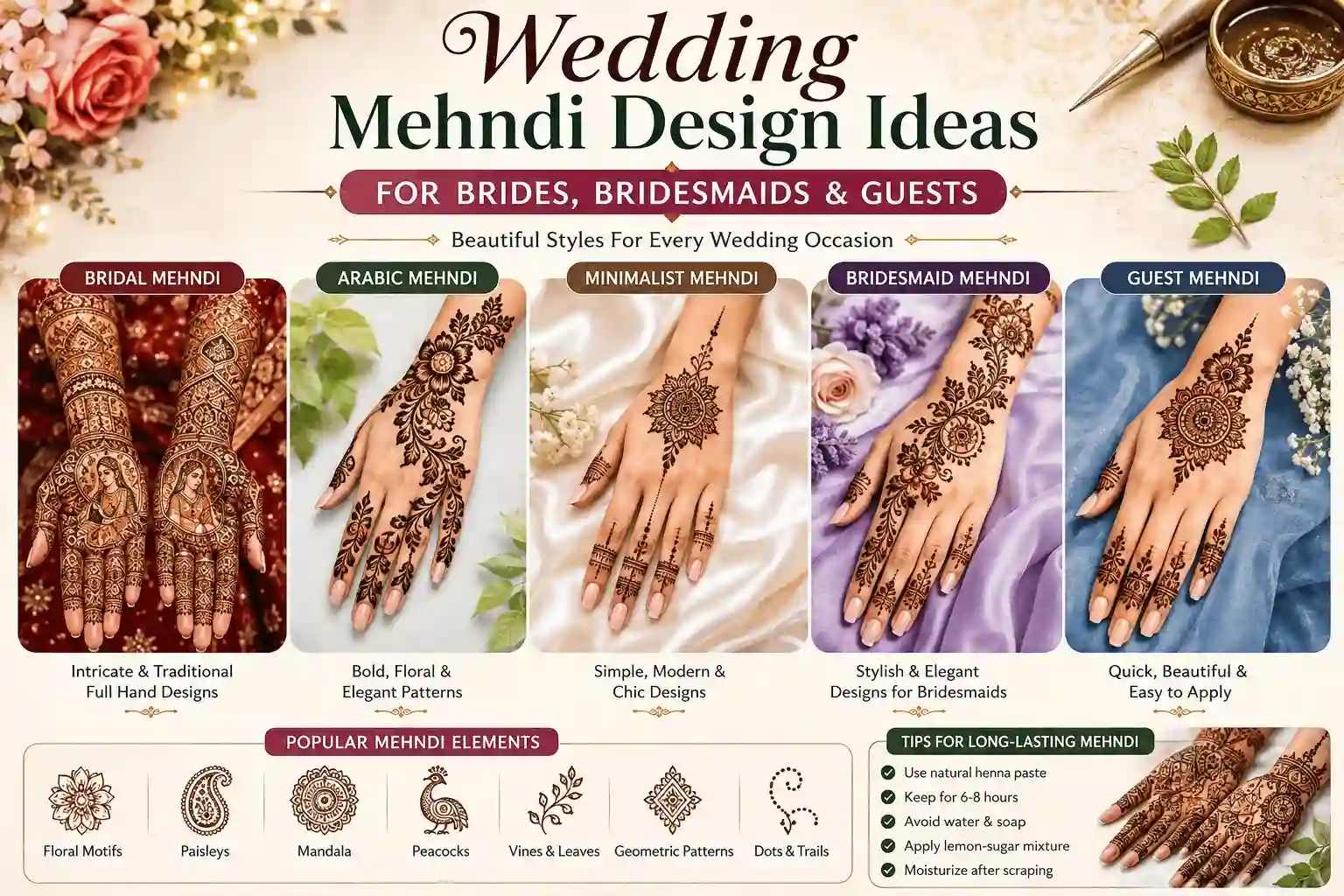
Choosing the right wedding mehndi design is about more than finding a beautiful reference image. Your design should match the wedding event, outfit, jewelry, available application time, hand placement, photography style, and the level of detail you actually want.
Wedding henna is used across many cultures and wedding traditions, and modern bridal designs range from highly detailed full-hand compositions to minimal floral patterns. The Knot, for example, describes wedding henna as temporary body art commonly applied to the hands, arms, and feet and highlights its importance across numerous cultural traditions.
For brides, a full-hand bridal mehndi can create a dramatic traditional appearance. Bridesmaids may prefer a lighter Arabic or floral pattern, while wedding guests often need something quicker and easier to wear.
This guide focuses on practical wedding mehndi design ideas so you can choose a style according to your event, application time, placement, outfit, and personal taste.
How to Choose the Right Wedding Mehndi Design
Before choosing a specific pattern, decide what role the mehndi needs to play in your wedding.
Questions to Ask Before Choosing a Design
Ask yourself:
- Who is wearing it: bride, bridesmaid, family member, or guest?
- Which event is it for: mehndi, engagement, nikah, dholki, baraat, or reception?
- How much time is available for application?
- Do you prefer traditional, modern, romantic, minimalist, or bold styling?
- Will the design need to work with bridal jewelry?
- Which parts of your hands will appear most often in photographs?
A current 2026 bridal mehndi guide similarly organizes designs by style, placement, event, and coverage, which is more useful than treating every design as interchangeable.
Choose the Design Structure Before the Details
Instead of immediately choosing individual flowers or paisleys, decide on the overall structure:
Main motif → supporting motifs → filler details → borders → negative space
This makes the finished pattern easier to understand and prevents the design from becoming overcrowded.
Full-Hand Bridal Mehndi Designs
A full-hand bridal mehndi design remains one of the most traditional choices for brides who want maximum detail and visual impact.
What a Full-Hand Design Can Include
A full bridal layout may extend across:
- Palm
- Fingers
- Wrist
- Back of the hand
- Forearm
- Sometimes feet and ankles
Traditional bridal patterns commonly combine paisleys, florals, vines, jaal work, circular motifs, fine fillers, and storytelling elements. Recent bridal guides also distinguish full Pakistani or Indian designs from lighter Arabic and minimalist styles.
Why Brides Choose Full-Hand Mehndi
Full-hand mehndi provides more space for visual storytelling and detailed composition.
It can be particularly effective for:
- Traditional weddings
- Mehndi ceremonies
- Bridal portraits
- Close-up ring photographs
- Heavy embroidered bridal outfits
- Brides who enjoy intricate patterns
Full-Hand Design Tip
Do not fill every available area simply because you have space.
A professional-looking composition usually needs a clear focal point and controlled negative space.
Pakistani Bridal Mehndi Designs
Pakistani bridal mehndi is often recognized by its fine detailing, layered motifs, vines, jaal patterns, paisleys, circular centers, and dense overall composition.
Popular Pakistani Mehndi Motifs
Common design elements include:
- Paisleys
- Floral jaal
- Bel or vine patterns
- Mandalas
- Peacocks
- Fine leaves
- Dotted chains
- Bracelet-style wrist bands
- Geometric fillers
Recent Pakistani design guides describe full-hand bridal layouts as combinations of palms, fingers, wrists, forearms, paisleys, florals, jaal details, and personalized elements.
How to Give Traditional Pakistani Mehndi a Modern Look
Traditional does not have to mean visually heavy.
You can modernize the design by:
- Making the main motifs larger
- Reducing unnecessary filler
- Using more negative space
- Keeping selected fingers lighter
- Introducing asymmetry
- Adding one meaningful personalized detail
A Balanced Pakistani Layout
Try:
Central palm motif → floral support → finger bands → wrist border → controlled forearm extension
This produces a complete bridal appearance without making every section equally dense.
Arabic Wedding Mehndi Designs
Arabic mehndi is a strong option when you want an elegant pattern with more visible skin between individual motifs.
These layouts commonly emphasize flowing flowers, leaves, vines, bold outlines, and diagonal movement. Recent 2026 design coverage also highlights open space and larger motifs as key characteristics of simple Arabic-style artwork.
Why Arabic Mehndi Works for Weddings
Arabic patterns can be useful for:
- Modern brides
- Engagements
- Nikah
- Bridesmaids
- Wedding guests
- Shorter application sessions
Instead of covering the complete hand with tiny details, the design can travel diagonally from the wrist toward the fingers.
Simple Arabic Layout Example
Wrist flower → curved vine → large leaves → finger accents
The open skin around the design creates contrast and makes the main motifs easier to see.
Minimalist Wedding Mehndi Designs
Minimalist mehndi is ideal for brides or guests who want something elegant without extensive coverage.
Minimal Mehndi Ideas
Consider:
- Single floral vines
- Small mandalas
- Tiny paisleys
- Finger accents
- Ring-style motifs
- Wrist bands
- Small geometric patterns
- One-sided floral trails
A simple design is not automatically an easy design. Precise spacing and clean lines can still require considerable control.
Best Minimalist Placements
Palm Center
A small mandala or flower creates an immediate focal point.
Back of Hand
A small botanical trail can complement rings and bracelets.
Wrist
A bracelet-inspired composition can look like jewelry.
Fingers
Individual bands, dots, leaves, or tiny floral details can create a finished appearance without filling the palm.
Floral Wedding Mehndi Designs
this is most versatile categories because flowers can be scaled from tiny guest patterns to elaborate bridal compositions.
You can use:
- Large flowers
- Small five-petal flowers
- Layered petals
- Floral clusters
- Rose-inspired motifs
- Lotus-inspired forms
- Leaf-and-flower vines
- Botanical borders
Floral Mehndi for Brides
Use larger flowers combined with paisleys, leaves, jaal, and fine detailing.
Floral Mehndi for Bridesmaids
Use one or two statement flowers with a flowing vine.
Floral Mehndi for Guests
A small floral cluster on the back hand or wrist can provide a festive look in considerably less space.
Why Floral Mehndi Is So Adaptable
A single floral structure can be enlarged, simplified, repeated, or combined with geometric elements, making it useful across different wedding roles.
Bride and Groom Storytelling Mehndi
Storytelling mehndi turns the hand into a visual part of the wedding narrative.
Storytelling Motif Ideas
You can include:
- Bride and groom figures
- Wedding ceremony scenes
- Couple portraits
- Decorative arches
- Doli-inspired scenes
- Initials
- Wedding dates
- Important symbols
Personalized bridal mehndi is increasingly used to incorporate names, dates, venues, symbols, and elements from a couple’s story rather than simply selecting a catalogue pattern.
How to Keep Storytelling Mehndi Readable
Do not crowd the main portrait with tiny filler elements.
Use this visual hierarchy:
Main scene → decorative frame → floral support → secondary motifs → small fillers
Storytelling Tip
Give the central scene enough negative space that it remains recognizable after the henna stain develops.
Personalized Wedding Mehndi Designs
Personalization can turn a beautiful design into a meaningful wedding keepsake.
Personalized Mehndi Ideas
Consider adding:
- Couple initials
- Wedding date
- Meaningful flower
- Special symbol
- Wedding venue
- First-meeting reference
- Family motif
- Cultural symbol
- Important phrase
- Favorite shared object
How Many Personal Elements Should You Add?
One or two important details are usually easier to integrate than a collection of unrelated symbols.
Example
Primary element: Couple initials
Secondary element: Wedding date
Then use floral, paisley, geometric, or architectural motifs as supporting artwork.
The goal should be a cohesive design rather than a collection of separate icons.
Back-Hand Wedding Mehndi Designs
The back of the hand deserves special attention because it is frequently visible in wedding photography.
Back-Hand Design Ideas
Popular structures include:
- Central mandala
- Floral lattice
- Hanging floral pattern
- Bracelet-style wrist
- Finger-to-wrist vine
- Geometric framework
- Delicate jaal
Why Back-Hand Placement Matters
Back-hand designs are often visible when the bride is:
- Holding flowers
- Showing a ring
- Holding wedding invitations
- Displaying jewelry
- Holding the groom’s hand
- Posing for close-up portraits
Photography Tip
The most important motif should sit in an area that remains visible when the hand is naturally positioned.
Front-Hand Wedding Mehndi Designs
The front hand is often the focal point during ring photographs and close-up bridal portraits.
Front-Hand Design Structure
A useful structure is:
Central motif + finger treatment + wrist transition
Popular Front-Hand Motifs
You can choose:
- Mandala
- Paisley
- Large flower
- Bride-and-groom scene
- Circular jaal
- Geometric medallion
Keep One Dominant Motif
Do not give every part of the palm identical visual weight.
One large central motif with finer surrounding work often creates more depth than numerous equally detailed sections.
Simple Wedding Mehndi for Bridesmaids
Bridesmaids usually need something attractive without the time commitment of a full bridal design.
Floral Wrist Trail
A flower begins near the wrist and moves upward through a flowing vine.
Finger Vine
One or two fingers receive detailed treatment while the palm remains relatively open.
Mini Mandala
A centered circular motif creates a polished and symmetrical appearance.
Bracelet Mehndi
A wrist cuff can make the design resemble jewelry.
Half-Hand Arabic Style
A diagonal floral composition creates strong visual impact without complete coverage.
For a related same-silo resource, you can connect this article to your Simple Mehndi Designs Guide.
Wedding Mehndi Designs for Guests
Wedding guests generally benefit from patterns that are faster, lighter, and easier to maintain.
Practical Guest Mehndi Ideas
Try:
- Small mandala with finger accents
- Floral vine with wrist detail
- Single paisley with leaf trail
- Minimal Arabic diagonal
- Tiny geometric composition
Guests do not need bridal-level coverage to achieve a festive appearance.
Guest Design Rule
Prioritize a clean shape and memorable focal point over the number of individual details.
Engagement Mehndi Design Ideas
Engagement mehndi often sits between minimalist and bridal styling.
Good Engagement Choices
Consider:
- One statement palm motif
- Fine finger detailing
- Thin wrist border
- Limited back-hand coverage
- Ring-finger accents
The design should leave enough visual room for engagement-ring photography.
Modern Geometric Wedding Mehndi
Geometric mehndi is a strong option for brides looking for a contemporary aesthetic.
Geometric Motifs
Try combining:
- Diamonds
- Circles
- Arches
- Triangles
- Grids
- Symmetrical bands
- Repeated dots
- Angular leaves
Why Geometry Requires Precision
Geometric designs expose inconsistencies quickly.
Uneven spacing, inconsistent line thickness, or mismatched repetition can become visually obvious.
For digital design preparation, Adobe’s official Illustrator documentation covers tools for creating and editing repeating patterns, which can be useful when developing repeatable motif references before manual application.
Peacock Mehndi Designs for Weddings
The peacock is a recognizable traditional motif that can become the centerpiece of a wedding design.
Peacock Placement Ideas
Use it as:
- Main palm motif
- Back-hand centerpiece
- Forearm extension
- Part of a storytelling composition
- Repeated side motif
Traditional Peacock Combination
Peacock + paisley + floral vine
Modern Peacock Combination
Peacock + geometric border + negative space
Peacock Design Tip
Keep the silhouette readable. Too much filler around the body and feathers can reduce the visual impact of the motif.
Mandala Wedding Mehndi Designs
Mandala designs provide a natural center for the palm.
Basic Mandala Structure
A simple mandala can be built using:
- Central dot or circle
- First petal ring
- Secondary decorative ring
- Dots
- Leaves
- Outer border
Small vs. Large Mandala
A small mandala works well for minimalist styling.
A layered large mandala can act as the central anchor of a bridal palm.
Mandala Design Tip
Symmetry matters more than excessive complexity.
A relatively simple mandala can appear sophisticated when spacing and repetition are consistent.
Wedding Mehndi Based on the Bridal Outfit
Your outfit can influence the appropriate visual language of your mehndi.
Heavy Embroidered Bridal Outfit
Choose a richer composition with stronger structure and more detailed motifs.
Minimal Contemporary Outfit
Arabic floral, botanical, geometric, and negative-space designs can complement a cleaner aesthetic.
Traditional Red Bridal Dress
Paisleys, flowers, peacocks, jaal work, and circular motifs can reinforce the traditional visual language.
Pastel or Modern Bridal Outfit
Fine-line floral and geometric designs can provide a lighter contrast.
Style-Matching Rule
Think about:
Dress + jewelry + makeup + mehndi + photography
rather than choosing the mehndi independently.
Choosing Mehndi Placement for Wedding Photography
Photography should be considered before the final design is drawn.
Important Wedding Photography Moments
Your hands may appear during:
- Ring close-ups
- Bouquet photographs
- Jewelry portraits
- Dupatta styling
- Couple hand portraits
- Invitation photographs
- Ceremony moments
A design that looks excellent in a flat reference image may not photograph well if the most important motif disappears when the fingers bend.
Design for Natural Hand Positions
Open Palm
Keep the dominant motif visible near the palm center.
Holding Flowers
Give the back of the hand a strong recognizable motif.
Wearing Bangles
Use the wrist area strategically so the pattern works with the jewelry.
Wedding Mehndi Design by Application Time
Application time should influence your design choice.
Designs for 10–20 Minutes
Consider:
- Finger vines
- Small floral motifs
- Tiny mandalas
- Wrist accents
Designs for 20–45 Minutes
Consider:
- Arabic floral trails
- Half-hand compositions
- Medium mandalas
- Bracelet designs
Designs for 45–90 Minutes
Consider:
- Detailed front-hand patterns
- Engagement-style compositions
- Larger back-hand layouts
Designs for 2 Hours or More
Consider:
- Full bridal palms
- Detailed front and back hands
- Personalized storytelling
- Extended forearm designs
Important Timing Note
These are planning ranges rather than guarantees. Application time varies according to artist experience, design density, coverage, hand size, and the complexity of the chosen pattern.
Common Wedding Mehndi Design Mistakes
Choosing a design without considering practical limitations can produce a disappointing result even when the reference itself is beautiful.
Choosing a Design Only Because It Looks Good Online
Problem: The reference may not suit your hand size, outfit, or schedule.
Solution: Choose the design structure first and adapt the motif to your needs.
Making Every Area Equally Dense
Problem: The pattern can become visually cluttered.
Solution: Combine detailed sections with purposeful negative space.
Ignoring Finger Design
Problem: The fingers may look disconnected from the palm.
Solution: Plan the finger treatment at the same time as the central motif.
Adding Too Many Personalized Elements
Problem: Names, dates, portraits, symbols, and quotes can compete for attention.
Solution: Select one or two meaningful details.
Choosing Bridal-Level Detail for a Short Function
Problem: The session may become impractical.
Solution: Match design complexity to your available time.
Designing Without Photography in Mind
Problem: The central motif may disappear in a natural hand position.
Solution: Design around the poses and objects likely to appear in your wedding photos.
Creating a Wedding Mehndi Reference Board
A reference board can make communication with your artist much easier.
What to Include
Add:
- One main design
- One finger style
- One wrist style
- One coverage example
- One personalized element
- One photograph showing the desired overall direction
Avoid giving your artist many contradictory references and expecting every element to fit naturally together.
Organize Your Inspiration
Create separate groups for:
- Motifs
- Borders
- Fillers
- Finger patterns
- Wrist designs
- Placement
- Personalization
This creates a clearer visual brief.
Wedding Mehndi Stencil-Friendly Design Ideas
Not every design has to start as completely freehand artwork.
For people working with templates, references, or stencil concepts, clear large-scale motifs are easier to simplify.
Good Motifs for Stencil Planning
Consider:
- Floral outlines
- Large paisleys
- Mandalas
- Leaves
- Geometric borders
- Bracelet patterns
- Simple peacock silhouettes
Basic Stencil Workflow
Choose motif → simplify lines → check spacing → transfer or print → add freehand details
This hybrid approach can provide consistency while preserving the handmade appearance of the final design.
For a related same-silo comparison, see our Mehndi Cone vs Stencil Guide.
Comparing Wedding Mehndi Styles
| Style | Coverage | Best For | Visual Effect |
| Full Bridal | High | Bride | Traditional and grand |
| Pakistani Traditional | High | Bride | Detailed and cultural |
| Arabic | Medium | Bride, bridesmaid | Flowing and elegant |
| Minimalist | Low | Guest, modern bride | Clean and refined |
| Floral | Low–High | Everyone | Romantic and versatile |
| Geometric | Low–Medium | Modern weddings | Precise and contemporary |
| Storytelling | High | Bride | Personal and memorable |
| Mandala | Low–Medium | Bride, guest | Balanced and centered |
| Peacock | Medium–High | Bride | Traditional and decorative |
| Bracelet Style | Low–Medium | Bridesmaids, guests | Jewelry-inspired |
Which Wedding Mehndi Style Is Best for You?
The best wedding mehndi design is not automatically the largest or most detailed option.
Choose Full Bridal Mehndi If:
- You want traditional bridal coverage.
- You enjoy intricate details.
- You have several hours available.
- Your wedding photography will feature your hands prominently.
Arabic Mehndi If:
- You prefer open space.
- You want larger motifs.
- You need a comparatively lighter composition.
- You like flowing floral designs.
Minimalist Mehndi If:
- You prefer contemporary styling.
- You want less coverage.
- You have limited application time.
- You want your jewelry to remain visually prominent.
Personalized Mehndi If:
- You want your design to tell a story.
- You have meaningful symbols or dates.
- You want something unique rather than catalogue-based.
Final Wedding Mehndi Design Selection Checklist
Before finalizing your wedding mehndi, check each of these points:
- Is the style suitable for the wedding event?
- Does the coverage match your preference?
- Do you have enough application time?
- Does the design complement your outfit?
- Will it work with your jewelry?
- Does the finger treatment match the palm?
- Is there enough negative space?
- Does the main motif have clear visual priority?
- Are personalized elements limited and meaningful?
- Will the important motifs remain visible in photographs?
- Have you provided your artist with one clear design direction?
When these factors are settled, choosing the final mehndi pattern becomes much easier.
Frequently Asked Questions About Wedding Mehndi Designs
What Is the Best Mehndi Design for a Wedding Bride?
A full-hand Pakistani or Indian-inspired bridal composition is a strong traditional choice for brides who want intricate detailing, personalized elements, and strong visual impact.
Which Mehndi Design Is Best for a Simple Wedding?
Arabic, floral, minimalist, and mandala designs can work particularly well for smaller or modern weddings because they can create an elegant appearance without full-hand coverage.
How Early Should I Choose My Wedding Mehndi Design?
Choose your design direction before the wedding day so you have enough time to discuss coverage, motifs, personalization, placement, and application time with your mehndi artist.
What Should I Add to Personalized Bridal Mehndi?
Consider initials, a wedding date, a meaningful flower, venue details, cultural symbols, or a small storytelling scene.
Is Arabic Mehndi Suitable for Brides?
Yes. Arabic mehndi can work for brides who prefer bold floral motifs, flowing layouts, and more visible negative space.
Can Simple Mehndi Look Bridal?
Yes. A bridal look depends on composition, placement, line quality, balance, and styling—not simply on maximum coverage.
Which Motifs Are Common in Traditional Bridal Mehndi?
Common motifs include paisleys, flowers, vines, mandalas, peacocks, jaal patterns, geometric fillers, wrist bands, and storytelling elements.
Can Wedding Mehndi Be Planned With Stencils?
Yes. Large, clearly defined motifs can be simplified into stencil-friendly shapes. A hybrid workflow can combine template placement with freehand detailing.
Learn More From High-Authority Sources
- The Knot — Wedding Henna Designs: Useful for wedding-specific henna inspiration, cultural context, placement, and bridal styling.
- Adobe Illustrator — Pattern Design: Useful for creating repeatable digital motifs and pattern references when planning designs digitally.
- Canva — Mood Boards: Useful for organizing wedding inspiration, motifs, colors, textures, and visual references into one design board.
- Encyclopaedia Britannica — Henna: Useful for background information about henna as a natural dye and its historical use.
refrences
- The Knot — Wedding Henna Designs
- Adobe — Official Illustrator Pattern Documentation
- Canva — Official Mood Board Guide
These sources are preferred over low-authority design aggregators because they provide stronger brand/domain authority and are relevant to wedding planning, design creation, and visual organization.