Medical Disclaimer: The information provided in this article, including Body Mass Index (BMI) calculations and health categorizations, is intended for general educational and informational purposes only. It is not a substitute for professional medical advice, diagnosis, or treatment. Always consult with a qualified healthcare provider or physician regarding your specific health needs and before making any significant changes to your diet, fitness routine, or lifestyle.
Have you ever calculated your Body Mass Index (BMI) using a standard online tool, received a “normal” or “healthy” result, and moved on with your day? For millions of people globally, standard BMI charts serve as the ultimate baseline for health. But what if that baseline is entirely inaccurate for your specific body type and genetic background?
If you were to take those exact same measurements to a clinic in Tokyo, the doctor might flag your chart for metabolic risks. This is because health metrics are not universally applicable. Different populations carry fat differently, and the threshold for weight-related diseases varies dramatically across the globe.
If you are looking for a Japanese BMI Calculator: Check Your Health Fast, you are already a step ahead of the curve. You recognize that global averages do not always apply to individual realities. Today, we are going to break down exactly why the Japanese medical community uses a stricter scale, how you can measure your metrics accurately at home, and the best privacy-focused tools to calculate your numbers without doing the manual math.
The Science: WHO vs. JASSO BMI Classifications
To understand why a specialized Japanese BMI calculator is necessary, we have to look at the data governing global health. The World Health Organization (WHO) established the standard BMI scale decades ago. It is a simple mathematical formula—weight in kilograms divided by height in meters squared—used to categorize human weight.
However, the WHO scale was primarily developed using data from Caucasian populations of European descent.
Medical researchers in East Asia quickly realized a problem: Japanese individuals were developing severe weight-related comorbidities, such as type 2 diabetes, cardiovascular disease, and hypertension, at significantly lower BMI levels than their Western counterparts. The issue wasn’t the total amount of fat, but where the fat was being stored. Asian populations have a higher genetic predisposition to accumulate visceral fat (fat stored deep within the abdominal cavity around vital organs) at lower body weights.
To combat this, the Japan Society for the Study of Obesity (JASSO) conducted extensive epidemiological studies and established a localized, stricter set of BMI criteria.
Here is the exact breakdown of how the two standards compare:
The Global WHO BMI Scale
- Underweight: Less than 18.5
- Normal Weight: 18.5 – 24.9
- fat: 25.0 – 29.9
- Obese: 30.0 and above
The Japanese (JASSO) BMI Scale
- Underweight: Less than 18.5
- Normal Weight: 18.5 – 24.9 (Note: A BMI of exactly 22.0 is considered the statistical ideal in Japan, associated with the lowest lowest risk of morbidity).
- Obesity Disease (Degree 1): 25.0 – 29.9
- Obesity Disease (Degree 2): 30.0 – 34.9
- Obesity Disease (Degree 3): 35.0 – 39.9
- Obesity Disease (Degree 4): 40.0 and above
The critical takeaway here—and the reason this matters for your health tracking—is the threshold for obesity. Under the WHO guidelines, a BMI of 26 is merely “fat,” a buffer zone before true medical concern kicks in. Under the JASSO guidelines, a BMI of 25 or higher is immediately classified as obesity.
How to Measure Your BMI Accurately at Home
Before you plug numbers into any calculator, you need to ensure your raw data is perfectly accurate. I frequently see users panic over a high BMI result, only to realize they weighed themselves incorrectly. Your weight fluctuates wildly throughout the day based on hydration, food intake, and sodium levels.
To get a true reading, follow this standardized clinical protocol:
- Time it Right: The most accurate time to weigh yourself is first thing in the morning, immediately after using the restroom and before drinking water or eating breakfast.
- Calibrate Your Scale: Place your digital scale on a hard, flat surface (like tile or hardwood). Never weigh yourself on a carpet or rug, as the uneven surface absorbs the pressure and provides an artificially low reading.
- Strip Down: Weigh yourself naked or in minimal, lightweight clothing. A pair of jeans and a heavy sweater can easily add three to four pounds to your total weight.
- Measure Your Height Barefoot: Stand flat against a wall with your heels, buttocks, shoulders, and the back of your head touching the surface. Look straight ahead, parallel to the floor. Have someone place a flat object (like a hardcover book) on the crown of your head and mark the wall. Measure from the floor to the mark.
Tool Recommendation: The DigitalOnDay Advantage
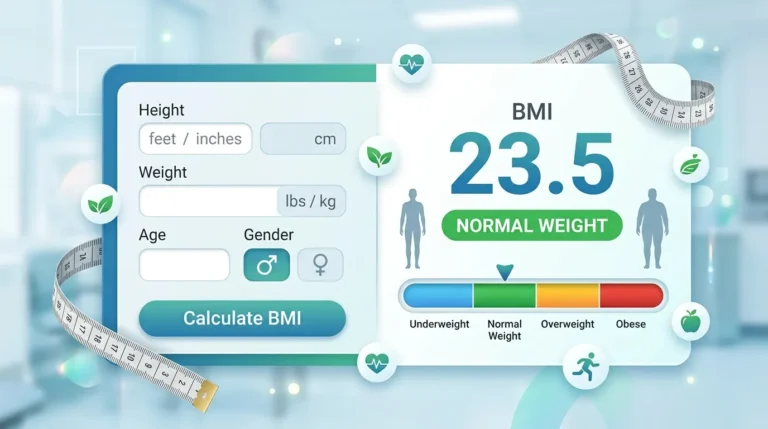
Calculating your BMI manually isn’t difficult math, but converting between pounds, kilograms, inches, and centimeters opens the door for human error. When you are tracking your health daily, you need a frictionless system.
For the most accurate, zero-hassle experience, I recommend using the DigitalOnDay Free Japanese BMI Calculator.
I favor this specific utility for a few key reasons. First, it is perfectly calibrated to the JASSO standards, meaning it won’t give you a false sense of security based on Western metrics. It immediately categorizes your result using the strict 25.0+ obesity threshold.
Second, and perhaps most importantly in today’s digital age, it is incredibly privacy-focused. Many health apps force you to create an account, log in, and surrender your personal health data to their servers just to get a basic calculation. The DigitalOnDay tool is entirely browser-based. It runs the math instantly on your own device, ensuring your height and weight data is never stored, tracked, or sold to third-party advertisers. It is a clean, fast, and professional resource built simply to save you time.
The Limitations of BMI: What the Numbers Don’t Tell You
While the JASSO BMI scale is an excellent, localized screening tool, any honest health professional will tell you that BMI is just one piece of a much larger puzzle. The formula was designed in the 1830s to evaluate populations, not individuals. It calculates mass, but it is completely blind to body composition.
If you are using a Japanese BMI calculator, you must keep these severe limitations in mind:
- Muscle tissue is significantly denser and heavier than fat tissue. If you are a bodybuilder, an athlete, or someone who regularly does resistance training, your BMI may classify you as being in a higher weight category under the JASSO scale—even if your body fat percentage is very low. This happens because BMI does not distinguish between muscle and fat, treating both the same in its calculation.
- Bone Density and Frame Size: Individuals with naturally broad shoulders, wide hips, or high bone density will naturally weigh more. The formula penalizes larger skeletal frames.
- The Aging Factor: As we age, we naturally lose muscle mass and replace it with fat. An senior person might have a “Normal” BMI of 23, but possess an dangerously high body fat percentage and low muscle mass (a condition known as sarcopenia). Conversely, some geriatric studies suggest a slightly higher BMI in the senior, can actually be protective against mortality from falls and illness.
- Pregnancy: BMI charts are entirely irrelevant for pregnant women, as the weight accounts for the developing fetus, placenta, amniotic fluid, and increased blood volume.
Therefore, if your JASSO BMI comes back high, do not immediately panic. Use it as a prompt to seek further, more specific testing from a doctor, such as a DEXA scan, skinfold caliper test, or an analysis of your waist-to-hip ratio, which provides a much clearer picture of visceral fat.
Frequently Asked Questions (FAQs)
Why is the Japanese BMI threshold for obesity so much lower than the US and Europe?
The threshold is lower due to genetic differences in fat distribution. Studies by the Japan Society for the Study of Obesity revealed that Japanese individuals experience a sharp increase in obesity-related diseases (like hypertension and diabetes) when their BMI reaches 25. In Caucasian populations, this same spike in disease risk typically doesn’t occur until a BMI of 30.
Should Asian use the JASSO scale or the WHO scale?
Many medical professionals recommend that individuals of East Asian descent refer to the stricter Asian BMI guidelines, regardless of where they currently live. Genetics dictate fat storage patterns more than geography. The World Health Organization has actually acknowledged this and released supplementary guidelines suggesting public health action points for Asian populations at a BMI of 23, 27.5, and 32.5.
What is considered the “perfect” or “ideal” BMI in Japan?
Statistically, JASSO research indicates that a BMI of exactly 22.0 is associated with the lowest incidence of weight-related diseases and the highest life expectancy in Japan. However, “ideal” is subjective, and an individual’s perfect weight depends heavily on their muscle mass and overall lifestyle.
Can children use the standard Japanese BMI scale?
No. Children and teenagers are constantly growing, meaning their height-to-weight ratio is a moving target. Pediatricians use specialized, age-and-sex-specific BMI percentile charts to evaluate a child’s growth trajectory, rather than the static adult formula.
Final Thoughts and Next Steps
Taking control of your health starts with understanding your baseline metrics. Relying on generalized global data can sometimes mask underlying risks, especially if your genetics dictate a different standard of care. By utilizing localized medical standards, you equip yourself with the exact knowledge needed to make informed lifestyle choices.
Stop relying on generic calculators that don’t account for specific demographic nuances. Head over to use the DigitalOnDay Free Japanese BMI Calculator to get your accurate, JASSO-compliant baseline in seconds. It is fast, secure, and requires zero sign-ups.
Final Medical Disclaimer: Please remember that the Body Mass Index is a generalized mathematical formula, not a comprehensive diagnostic tool. A high or low BMI reading does not guarantee the presence of disease, nor does a normal reading guarantee perfect health. Always share your metrics with a licensed physician or registered dietitian who can evaluate your complete medical history, lifestyle, and body composition before embarking on any weight loss or fitness regimen.