Last month I watched a 6’0″ firefighter type 219 lb into a BMI tool on his phone and wince when it flashed “higher weight.” His DEXA scan (done for a department fitness program) showed ~14% body fat leaner than most guys his age. That moment is why I like BMI for a fast screening check, but I don’t worship it.
This guide gives you a mobile-first BMI calculator, shows you exactly how the math works (metric and imperial), and then helps you interpret the number safely—especially if BMI is likely to misread you.
BMI calculator: quick, no-confusion tool (metric + imperial)
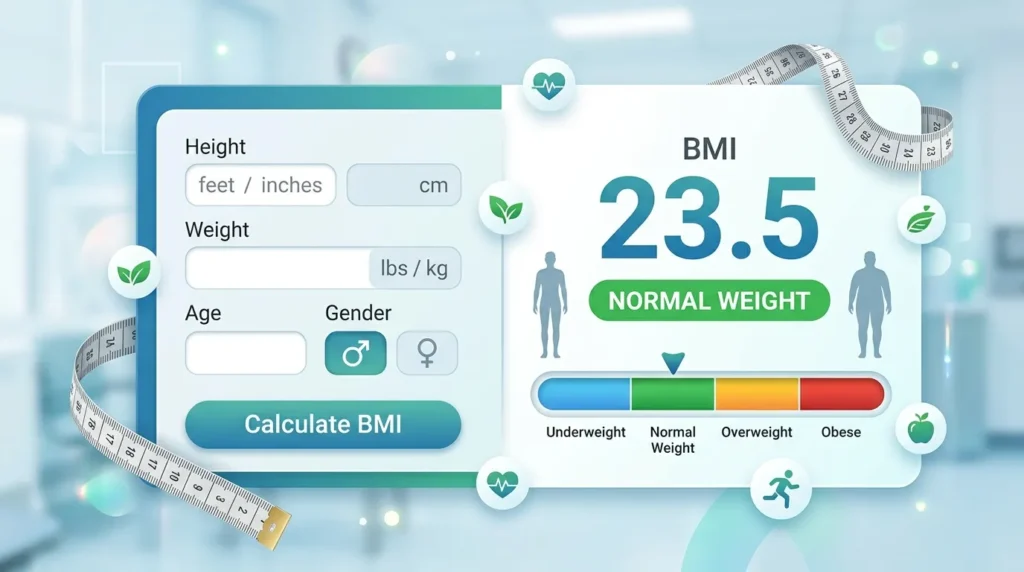
Step 1) Pick your units
- Metric: kilograms + meters (or centimeters)
- Imperial: pounds + feet/inches
Step 2) Enter your height and weight
If you’re doing this by hand, use the formulas below (and double-check with the worked examples).
Step 3) Read your result and run the “BMI Interpretation Check” (5 questions)
BMI is a weight-to-height ratio. It’s not a body fat test, and it doesn’t measure where fat sits. Two people can share the same BMI and have very different health risk.
Input rules I use in my own tools (so you don’t get nonsense results)
- Height must be > 0 (yes, people accidentally leave it blank)
- Weight must be > 0
- Convert carefully:
- 1 inch = 2.54 cm
- 1 foot = 12 inches
- 1 lb = 0.453592 kg
- Rounding: I round BMI to one decimal place (that’s how most clinical and public-health references show it). Don’t obsess over 0.1 changes—your hydration can swing your weight more than that.
Privacy note: a good calculator shouldn’t store your inputs. If you’re using an app (MyFitnessPal, Fitbit, Withings), check its data-sharing settings.
What BMI is and how the BMI formula works (kg/m²)
BMI stands for Body Mass Index—a simple index of weight relative to height.
Historically it comes from Adolphe Quetelet’s “Quetelet Index” (1830s), and it was later popularized in modern health research by Ancel Keys, who showed it works reasonably well for population-level comparisons. The World Health Organization (WHO) BMI classification is what most charts and clinics still reference.
The BMI formula (metric BMI calculation, kg/m²)
[
\text{BMI}=\frac{\text{weight (kg)}}{(\text{height (m)})^2}
]
Worked metric example
- Weight: 70 kg
- Height: 1.75 m
- BMI = 70 / (1.75²) = 70 / 3.0625 = 22.9 kg/m²
That lands in the healthy BMI range for adults.
How to use a BMI calculator (metric and imperial) + example calculations
Imperial BMI calculation (lbs/in²)
In imperial units, BMI uses a conversion factor:
[
\text{BMI}=\frac{\text{weight (lb)}}{(\text{height (in)})^2}\times 703
]
Worked imperial example
- Weight: 185 lb
- Height: 5’10” = 70 in
- BMI = (185 / 70²) × 703
= (185 / 4900) × 703
= 0.03776 × 703
= 26.5
That falls into the higher weight and obesity classification system as higher weight (more on categories below).
Common mistake I see (even in “smart” apps)
People enter 5.10 as height thinking it means 5’10”. Many calculators read that as 5.1 feet (= 61.2 inches) which spikes BMI dramatically. Always use feet + inches (or inches only), not decimals.
BMI categories (higher weight, healthy, higher weight, stoutness classes) and what they mean
For adults (age 20+), the standard cutoffs used by WHO, NIH resources, Mayo Clinic, NHS tools, and many U.S. clinics look like this:
Adult BMI categories (WHO/NIH-aligned)
- Underweight BMI: < 18.5
- Healthy weight: 18.5–24.9
- higher weight: 25.0–29.9
- Obesity Class I: 30.0–34.9
- Obesity Class II: 35.0–39.9
- Obesity Class III: ≥ 40.0
A key nuance: risk doesn’t jump like a light switch at 25 or 30. Cardiometabolic risk tends to rise gradually, and for some groups it rises earlier (I’ll cover ethnicity and waist measures in a minute).
What BMI can tell you (practically)
- A fast screening snapshot for weight status
- A rough way to estimate an “ideal weight for height” range (not a single number)
- A starting point for conversations about blood pressure, lipids, glucose, sleep apnea, joint pain, and activity capacity
What BMI can’t tell you
- Your body fat %
- Your fat distribution (central vs peripheral)
- Your muscle mass, bone density, or fluid retention
If you want “what am I made of?” data, you’re looking at DEXA (gold standard for body composition in many clinical/sports settings) or decent bioelectrical impedance analysis (BIA) scales like Withings Body+ or Tanita—useful for trends, not perfect truth.
The “BMI Interpretation Check” (5 questions that prevent bad takeaways)
When I coach people, I don’t interpret BMI until I ask these five questions. Answer them for yourself:
1) Age: Under 20? Over 65?
2) Sex at birth: Male or female (this affects body fat distribution and typical lean mass)
3) Build: Are you noticeably muscular (strength athlete, tactical job, heavy lifting)?
4) Waist: What’s your waist measurement (and your height, for waist-to-height ratio)?
5) Medical context: Pregnancy, postpartum, edema, steroids, thyroid disease, diabetes, high BP, or sleep apnea?
Quick takeaways (use these with your BMI result)
- Muscular build + high BMI: BMI likely overestimates fat → check waist-to-height ratio and/or body fat %.
- Normal BMI + large waist: BMI likely underestimates risk → central adiposity matters more than the scale.
- Older adult + normal BMI: watch for sarcopenia (low muscle) → you can have “normal BMI” with high body fat %.
- Pregnancy/postpartum: BMI is often not the right tool for short-term decisions → use OB/midwife guidance.
- Under 20: adult cutoffs don’t apply → use BMI-for-age percentiles (next section).
Limitations of BMI: muscle mass, body composition, sex, ethnicity, age, and pregnancy
BMI is popular because it’s cheap and quick, not because it’s perfect.
1) Muscle mass and athletic builds (misclassified as higher weight)
In 2026 I still see this weekly: a muscular person lands at BMI 27–30 and assumes they “need to lose weight.” If their waist is modest and labs are good, the priority may be conditioning, sleep, and nutrition quality, not aggressive weight loss.
My real-world observation: when I compared numbers across Fitbit’s dashboard (weight trend + resting HR) and a DEXA report for a recreational powerlifter, BMI barely changed over 12 weeks while body fat dropped ~3 points. BMI didn’t “see” the win.
2) Sex differences (BMI for people of all genders)
BMI cutoffs are the same for people of all genders but the biology isn’t. On average, women carry a higher essential fat percentage and store fat differently. That’s why pairing BMI with waist measures usually improves the picture.
3) Ethnicity and risk at lower BMI
This is a big one that many calculators ignore. In clinical practice, some populations—especially many Asian groups—tend to show higher cardiometabolic risk at lower BMI than the standard cutoffs suggest. If you’re in a group where clinicians use lower screening thresholds, talk with your primary care clinician about what targets make sense for you.
4) Age (older adults and sarcopenia)
Older adults can lose muscle (sarcopenia) while keeping or even gaining fat. BMI may look “fine” while strength, balance, and metabolic health slide.
Insider tip: for adults 60+, I care as much about grip strength, chair-stand time, protein intake, and waist-to-height ratio as I do about BMI.
5) Pregnancy, postpartum, and fluid shifts
Pregnancy changes body mass for good reasons. Postpartum, sleep deprivation, lactation, and fluid shifts can make weight a misleading signal week-to-week. BMI can be used in some pre-pregnancy risk screening, but it’s not a DIY score to manage pregnancy health.
6) Edema, medications, and medical conditions
Steroids, certain diabetes meds, heart/kidney issues, and edema can move scale weight without reflecting fat gain. If your weight changed rapidly (say 5–10 lb in a week) with swelling or shortness of breath, that’s a medical flag—not a BMI problem.
BMI for children and teens: BMI-for-age percentiles (adult ranges don’t apply)
For kids and teens (ages 2–19), you don’t interpret BMI using adult BMI categories. You use BMI-for-age percentiles based on CDC BMI-for-age growth charts (U.S.)—and they’re sex-specific.
How pediatric BMI works (plain English)
- You still calculate BMI the same way.
- Then you compare it to other kids of the same age and sex.
- The result is a percentile, not an adult category.
Typical CDC-style weight status categories (2–19)
(Clinics may phrase them slightly differently, but this is the common structure.)
- Underweight: < 5th percentile
- Healthy weight: 5th to < 85th percentile
- Overweight: 85th to < 95th percentile
- Obesity: ≥ 95th percentile
You’ll also see references to the International Obesity Task Force (IOTF) cutoffs in research, and the American Academy of Pediatrics (AAP) emphasizes interpreting growth patterns over time, not single points.
What to do today: If you’re a parent, don’t rely on an adult BMI chart from the internet. Use the CDC percentile calculator or ask your pediatrician for the percentile and trend line.
Better health-risk measures to pair with BMI (and why they matter)
If you take only one thing from this article, take this: BMI + waist measure beats BMI alone for most adults.
1) Waist circumference (simple, powerful)
How to measure (the way that stays consistent):
- Stand relaxed, breathe out normally
- Measure at the top of the hip bones (often close to the belly button)
- Use the same tape, same spot, same time of day
Practical cutoffs used widely in clinical screening (U.S. adult):
- Men: risk tends to rise around ≥ 40 in (102 cm)
- Women: risk tends to rise around ≥ 35 in (88 cm)
These thresholds show up across public health and clinical guidance (NIH-derived resources and many medical systems). They aren’t perfect for every ethnicity or body type, but they’re a strong “pay attention” signal.
2) Waist-to-height ratio (WHtR): my go-to add-on
WHtR is simple:
[
\text{WHtR}=\frac{\text{waist}}{\text{height}}
]
Rule of thumb: aim for < 0.5.
That’s the famous “keep your waist to less than half your height” screening idea, used in many WHtR screening protocol discussions.
Example:
- Height: 70 in
- Waist: 36 in
- WHtR = 36/70 = 0.51 → I’d treat that as higher risk even if BMI looks “only mildly higher weight”
3) Waist-to-hip ratio vs BMI
A waist-to-hip ratio can add nuance (especially for fat distribution), but it’s easier to measure waist wrong than hip right. For most beginners, WHtR is the cleaner win.
4) Body fat % (helpful, but don’t get tricked by the precision)
- DEXA: best detail, costs more, usually available through clinics/sports med and some imaging centers.
- BIA scales (Withings, Tanita): decent for trends if you measure under the same conditions (morning, after bathroom, before food). Hydration can swing readings.
5) Metabolic markers (the “so what?” numbers)
If BMI or waist suggests risk, confirm with:
- Blood pressure
- Fasting glucose or A1C
- Lipids (HDL, LDL, triglycerides)
- Sleep quality and potential sleep apnea symptoms
This lines up with how the USPSTF frames obesity screening: BMI is an entry point, not the full assessment.
How to interpret your BMI result and decide next steps (what I’d do)
Here’s how I guide people after they get a number. Not as a diagnosis—more like a map.
If your BMI is under 18.5 (underweight)
Do today:
- Track intake for 3 days (MyFitnessPal works fine) to see if calories/protein are low.
- If you have fatigue, hair loss, missed periods, GI symptoms, or unintentional loss: book a clinician visit.
Goal setting: prioritize strength training + adequate protein and sleep. Underweight can be medical, not just “fast metabolism.”
If your BMI is 18.5–24.9 (healthy range)
Do today:
- Measure waist and compute WHtR. If WHtR is ≥ 0.5, focus on central fat reduction and metabolic health even if BMI is “normal.”
- Pick one behavior target for 2 weeks: 7,000–9,000 steps/day, 25–35g fiber/day, or 2 strength sessions/week.
If your BMI is 25–29.9 (higher weight)
Do today:
- Add waist circumference and WHtR. This often tells you if weight is mostly muscle, mostly central fat, or mixed.
- Set a small, measurable target: 0.5–1.0% of body weight loss per week is a common safe ceiling for many adults (slower is fine and often more sustainable).
Red flags to escalate: high BP, snoring/daytime sleepiness, A1C creeping up, strong family history of type 2 diabetes.
If your BMI is 30+ (obesity classes I–III)
Do today:
- Don’t rely on DIY guessing. Use BMI as a screening trigger to get clinical support, especially if you have BP/glucose/lipid issues.
- Ask your clinician about evidence-based options: nutrition plan, activity progression, sleep apnea evaluation, and (when appropriate) anti-obesity meds or bariatric referral per current medical guidance.
Honest note: I’ve seen people burn 6 months on extreme workouts when the highest ROI was actually treating sleep apnea first. Once sleep improved, appetite control and training consistency followed.
A quick “target weight range” from BMI (useful, not sacred)
If you want an ideal weight for height range using BMI:
- Lower end (healthy): BMI 18.5 × height²
- Upper end (healthy): BMI 24.9 × height²
You can compute that in metric (kg) or imperial (convert after). This gives a range, not destiny.
Mini case study (Q1–Q2 2026): when BMI alone gave the wrong plan
In February 2026 I worked with a 34-year-old male shift worker (5’9″, 204 lb). His BMI was 30.1 (Obesity Class I), and he’d already tried “eat less, run more” for months with little progress.
What we changed (first 2 weeks):
- Measured waist: 41 in, height: 69 in → WHtR 0.59
- Sleep screen suggested high sleep-apnea risk; he got tested and started CPAP.
- We set a basic plan: protein at each meal, 2 short strength sessions/week, and a step floor of 7,000/day.
Results by week 10:
- Weight: -14 lb
- Waist: -3.5 in
- Resting HR (Fitbit trend): down ~6 bpm
- He reported fewer late-night cravings within the first 10 days after CPAP
BMI was useful—it flagged a problem. Waist measures and medical follow-through made the plan work.
Common pitfalls (what to watch out for)
- Treating BMI like a diagnosis. It’s a screening tool. NIH and USPSTF-style guidance treats it as a starting point.
- Ignoring waist size. Central fat drives risk more strongly than scale weight in many people.
- Obsessing over tiny changes. If your BMI shifts 0.2, that might be water, glycogen, or a salty meal.
- Using adult BMI categories for teens. Use CDC BMI-for-age percentiles.
- Using one measurement time. Trends matter. Recheck monthly, not hourly.
FAQ (real questions I get all the time)
What’s an “ideal BMI”?
For most adults, the healthy BMI range is 18.5–24.9, but “ideal” depends on waist size, labs, fitness, age, and medical history. I’d rather see BMI 26 with a WHtR < 0.5 and great labs than BMI 23 with a large waist and high blood pressure.
How accurate is BMI?
It’s reasonably accurate for population screening and for many average-build adults. It’s less accurate for athletes, very muscular people, older adults with low muscle, pregnancy/postpartum, and some ethnic groups where risk rises at lower BMI.
Are BMI cutoffs the same for people of all genders?
The category thresholds are the same, but body composition differs. That’s why pairing BMI with waist measures improves interpretation for both sexes.