Medical Disclaimer: The information in this article is for general education only. It does not replace professional medical advice or clinical treatment. Always talk to a licensed doctor before changing your diet, exercise routine, or lifestyle.
Millions of people use the Body Mass Index (BMI) to check their health. You step on a scale and check your weight. Then, you enter your height into a digital tool. This quick math gives you a basic health score. Doctors and insurance companies use this simple method everywhere.
However, medical understanding has changed in recent years. Experts found a major flaw in this global approach. People around the world store body fat in very different ways. A “healthy” weight for a European person might cause severe health risks for an Asian person.
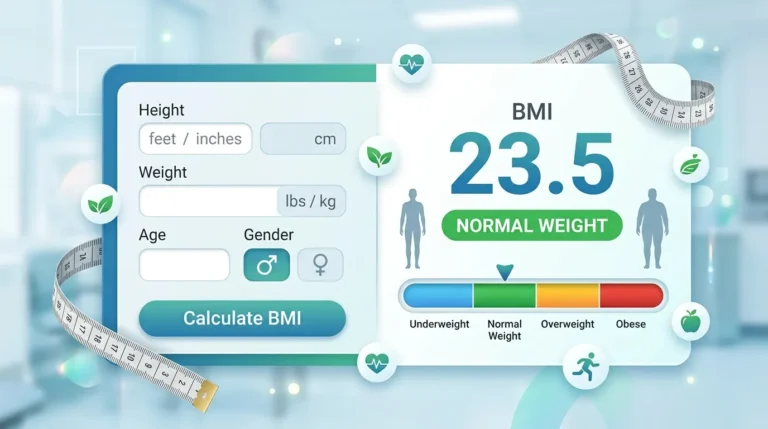
Many people search online for an ideal weight & obesity calculator to find your healthy body weight instantly. If you use one, you must know which medical rules the tool follows.
Today, we will explain the major differences between two medical standards. We will look at the global World Health Organization (WHO) rules. Then, we will compare them to the strict Japanese rules from the Japan Society for the Study of Obesity (JASSO). This guide will help you measure your health accurately.
The Science: WHO Guidelines vs. JASSO Classifications
To understand these different health scales, we must look at the data. The World Health Organization (WHO) created the global standard decades ago. They built this scale using health data from Western countries.
The WHO scale assumes something very specific. It assumes that major diseases only happen when a person carries a massive amount of extra weight. These diseases include type 2 diabetes and high blood pressure.
However, doctors in East Asia noticed a very different trend. Japanese people were developing these severe diseases at much lower body weights. The problem was not the total amount of fat. The real danger was where the fat was stored inside the body.
Asian populations have a strong genetic tendency to store belly fat. This specific fat wraps tightly around vital organs like the liver. This deep fat is very active and quickly causes insulin resistance.
To fix this problem, the Japan Society for the Study of Obesity (JASSO) took action. They created a much stricter set of BMI rules. This new scale accurately matches the real health risks for the Japanese population.
Here is a clear comparison of how these two medical standards differ:
The Global Standard: WHO BMI Classifications
- Underweight: Less than 18.5
- Normal Weight: 18.5 – 24.9
- Fat: 25.0 – 29.9
- Obesity (Class 1): 30.0 – 34.9
- Obesity (Class 2): 35.0 – 39.9
- Obesity (Class 3): 40.0 and above
The Japanese Standard: JASSO BMI Classifications
- Underweight: Less than 18.5
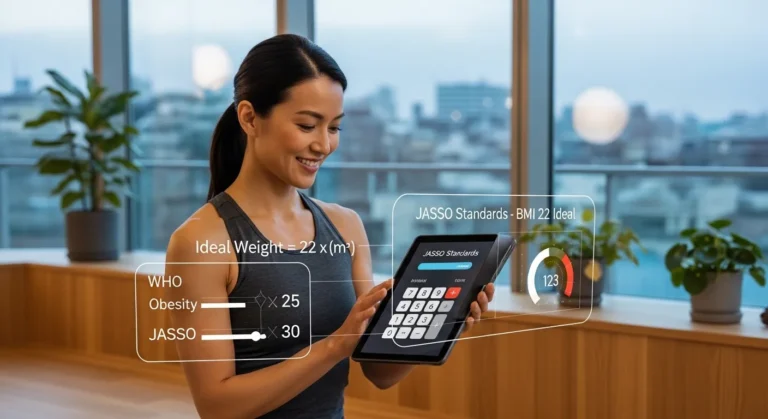
- Normal Weight: 18.5 – 24.9 (Note: A BMI of exactly 22.0 is the statistical ideal in Japan. It carries the lowest disease risk).
- Obesity Disease (Degree 1): 25.0 – 29.9
- Obesity Disease (Degree 2): 30.0 – 34.9
- Obesity Disease (Degree 3): 35.0 – 39.9
- Obesity Disease (Degree 4): 40.0 and above
The Critical Difference: Look closely at the threshold for disease. Under global WHO rules, a BMI of 26 is just considered Fat. It is a warning, but not a medical emergency. However, under JASSO rules, a BMI of 25.0 is immediately classified as a medical issue. This stricter rule helps doctors treat higher-weight patients much earlier.
How to Measure Your BMI Accurately at Home
A health calculator is only as good as the numbers you provide. Many people guess their height. Others weigh themselves at the wrong time of day. These simple mistakes lead to wrong results and bad health anxiety.
Follow this exact step-by-step routine to get accurate numbers:
- Time Your Check: Your body weight changes all day long. Water and food change the numbers. The best time to weigh yourself is early in the morning. Do it right after using the restroom and before eating anything.
- Place Your Scale: Put your digital scale on a hard, flat floor. Tile or wood floors are perfect. Never place your scale on a soft carpet. The soft rug absorbs your weight and gives a false low number.
- Wear Less Clothing: Weigh yourself with very little clothing. Heavy jeans and thick sweaters add extra pounds. This fake weight will instantly ruin your BMI results.
- Measure Height Correctly: Do not guess how tall you are. Stand completely barefoot against a flat wall. Your heels and shoulders must touch the wall. Look straight forward. Have a friend place a flat book on your head. Mark the wall and measure from the floor.
Tool Recommendation: A Smarter, Private Way to Calculate
Once you have exact numbers, you need to do the math. Doing the math by hand can cause simple errors. Also, most standard online tools use the Western WHO scale. If you want strict, preventative health tracking, those generic tools might fail you.
For the most accurate results, we recommend using the DigitalOnDay Free Japanese BMI Calculator.
This digital tool is custom-built for exact precision. It processes your numbers using the strict JASSO guidelines. It tells you your health status based on the important 25.0 threshold.
This tool also protects your personal privacy completely. Many fitness apps force you to create an account. They take your personal health data and sell it to others. The DigitalOnDay tool works entirely on your own device browser. Your personal metrics are never saved, tracked, or shared online. It is a fast, safe, and free way to check your health.
The Limitations of BMI: What the Numbers Miss
The JASSO scale is a great starting point for checking your health. However, you must understand that BMI is not a perfect system. It measures your total body mass, but it ignores your actual body composition.
You must keep these physical facts in mind when reading your results:
- Heavy Muscle Mass: Muscle tissue weighs much more than body fat. Athletes and weightlifters often get a very high BMI score. The basic math formula cannot tell the difference between healthy muscle and dangerous belly fat.
- Aging Bodies: As humans get older, they naturally lose muscle mass. Body fat usually replaces this lost muscle. Older people might have a “normal” BMI score. However, they might actually have a high fat percentage and weak muscles.
- Thick Bone Density: The math formula punishes people with wide shoulders or thick bones. A large skeleton naturally carries more weight.
- Pregnancy Changes: BMI charts do not work for pregnant people at all. Total body weight during pregnancy includes the baby, extra fluids, and more blood volume.
A high BMI result is not a reason to panic instantly. Instead, use it as a smart reason to visit your doctor. A doctor can order better tests to check your true body fat levels.
Frequently Asked Questions (FAQs)
Why is the Japanese health standard stricter than the US standard?
The rule is stricter because of simple genetics. Studies show that East Asian populations face severe health risks at a lower weight. Their risk for diabetes spikes at a BMI of 25.0. Western populations usually do not face this spike until a BMI of 30.0.
Which scale should I use if I am Asian but live in Europe?
Doctors suggest that people of East Asian descent use the stricter Asian rules. Your genetics control how you store fat, not your home address.
What is the “perfect” BMI score in Japan?
Medical research in Japan shows that a BMI of exactly 22.0 is the best goal. This specific number carries the lowest risk for long-term weight diseases.
Does a BMI calculator tell me my exact body fat percentage?
No, it does not. It only compares your total weight against your total height. You need a medical scan to measure your actual body fat percentage.
Conclusion and Next Steps
Taking control of your health starts with knowing your real numbers. However, relying on generic global data can hide serious health risks. Using a localized, strict medical standard like the JASSO framework is much safer. It gives you the clear facts needed to make smart lifestyle choices.
Stop using basic calculators that ignore important human genetics. Take two minutes today to use the DigitalOnDay Free Japanese BMI Calculator. It is the fastest, safest way to check your exact health status without sharing your private data.
Final Medical Disclaimer: The Body Mass Index is only a basic math tool. It is not a complete medical diagnosis. Always share your results with a licensed doctor or a trained dietitian. They can check your full medical history before you start a new diet or fitness plan.
Check Full Health Instructions in jp > Pharmaceuticals and Medical Devices Agency