Introduction
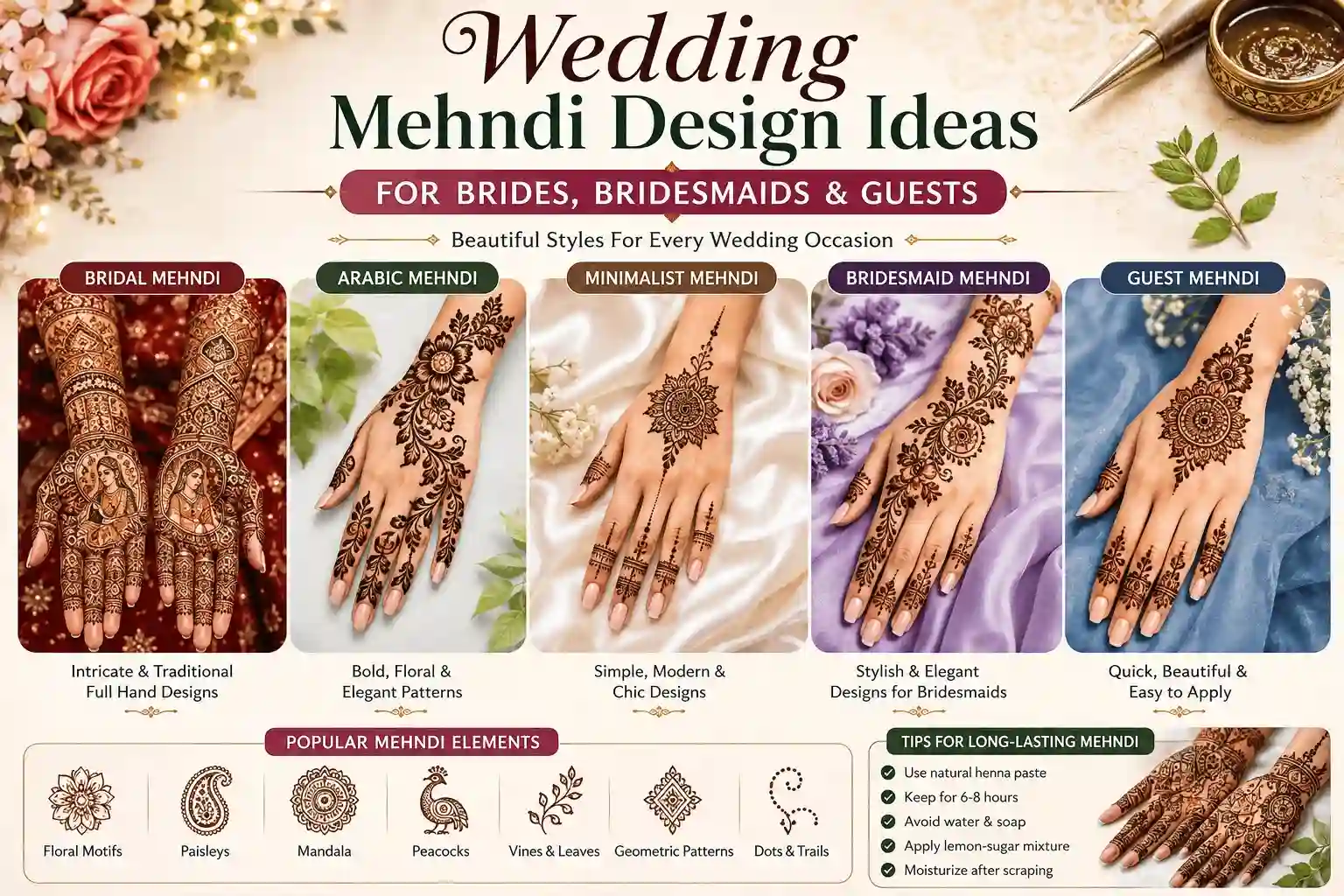
Wedding mehndi design ideas range from detailed bridal palms to simple floral trails for bridesmaids and guests. Choose your design by coverage, placement, personal style, and the time available for application. A clear central motif, coordinated finger details, and thoughtful spacing can make both elaborate and minimal patterns feel complete.
The right choice should also work with your outfit and jewelry. A wrist cuff may disappear beneath bangles, while a delicate back-hand vine can frame a ring beautifully. Planning those details before your appointment helps your artist adapt the reference to your hands.
This guide brings together bridal, Arabic, floral, geometric, and personalized ideas, along with practical ways to brief your artist. For more template-based inspiration, explore our mehndi and festive stencil designs guide.
Which Wedding Mehndi Style Should You Choose?
Start with the amount of coverage you want, then choose the motifs. These combinations are starting points, not rules about what a bride or guest must wear.
| Style | Typical coverage | A useful choice for | Design direction |
|---|---|---|---|
| Full bridal composition | Palms, fingers, wrists, with optional forearms | Brides who enjoy intricate work | Large focal motifs with connected borders and fillers |
| Arabic floral trail | Part of the palm or back of the hand | Brides, bridesmaids, or guests who prefer open space | Flowers and leaves following a curved or diagonal line |
| Minimal mandala | Palm center with light finger accents | Small ceremonies or understated styling | One circular motif with balanced spacing |
| Floral bracelet | Wrist with an optional finger connection | Bridesmaids and engagement looks | A narrow band, flower, and delicate connecting trail |
| Personalized storytelling | Selected palm or forearm areas | Couples who want meaningful details | Initials, a date, or one carefully framed scene |
| Geometric pattern | Fingers, wrist, or back of the hand | Contemporary styling | Repeated diamonds, arches, or bands |
Before saving a reference, ask whether you like its overall structure or just one detail. You might love a flower but prefer half the coverage shown in the original photograph.
Wedding Mehndi Design Ideas for Brides
Full-Hand Bridal Mehndi
For a detailed bridal look, build the design around one main palm motif, then connect it to the fingers and wrist. A large paisley, flower, or circular medallion gives the smaller details something to support.
One possible layout uses a palm medallion, alternating finger bands, a floral wrist border, and a short forearm extension. Keep some open space between those sections so the main shapes remain distinct.
Specify exactly what “full hand” means when booking. Both palms, both backs, wrists, and forearms create a different appointment from palms and fingers alone. Our bridal mehndi stencil patterns guide offers additional ideas for planning the main shapes.
Pakistani-Inspired Bridal Patterns
For a Pakistani-inspired composition, consider combining paisleys, floral vines, latticework, and fine finger details. These motifs overlap across regional traditions, so use the label to communicate a direction rather than a fixed formula.
Try a large paisley beside a palm flower, a light lattice section near the wrist, and repeating leaf bands on the fingers. If you prefer a less crowded result, enlarge the main motifs and reduce the filler between them.
Share any family or cultural preferences with your artist. The most meaningful design may draw on a familiar pattern rather than an online trend.
Peacock Mehndi With a Clear Silhouette
A peacock can become the focal point of a palm or forearm design. Give the head, curved neck, and feather shape enough space to remain recognizable.
For a detailed version, surround the bird with a narrow floral frame and small paisleys. For a lighter version, use a single peacock with an open border and restrained finger accents. Avoid squeezing a large reference into a small area without simplifying it.
Bride-and-Groom Storytelling Designs
A storytelling composition can include a couple illustration, an architectural arch, or a meaningful ceremony detail. Choose one central scene and let flowers or borders frame it.
Portraits and small figures need a different level of detail from simple motifs. Ask to see your artist’s examples of similar work and agree on how much space the scene needs. If the palm feels crowded, move the secondary detail to the wrist or forearm.
Arabic and Floral Wedding Mehndi Designs
Diagonal Arabic Floral Trail
A diagonal floral trail creates movement from the wrist toward one finger. Begin with a larger flower near the wrist or lower hand, add a curved vine, and finish with smaller leaves and finger accents.
The visible skin between motifs helps define the pattern. You can keep the trail narrow for a guest design or extend it with a second branch for more coverage. Browse our Arabic mehndi stencil designs collection for related layout ideas.
Rose and Leaf Back-Hand Design
Place a rose-inspired flower slightly off center on the back of the hand, then curve a leaf trail toward the index or middle finger. Keep the opposite side relatively open to give the flower visual emphasis.
This layout can complement a ring without surrounding every finger with dense detail. If you wear a statement bracelet, end the vine above it rather than hiding the main flower beneath the jewelry.
Lotus or Layered Floral Palm
A layered flower can anchor a bridal palm or an engagement design. Use a distinct outer silhouette, then add smaller petal details inside it. Match the finger patterns with a repeated leaf or petal shape.
Floral designs are easy to adapt across a wedding party: the bride can use a larger composition while others choose a smaller version of the same motif. Our floral mehndi stencil ideas explore flowers, vines, and bracelet arrangements.
Simple Mehndi Designs for Bridesmaids
Bridesmaid mehndi can coordinate without being identical. Choose one shared element, such as a flower, leaf shape, or wrist border, and allow each person to choose the coverage they prefer.
Three adaptable options are:
- Floral wrist trail: One flower near the wrist with a short vine extending onto the hand.
- Mini mandala: A small palm circle with one repeated finger detail.
- Bracelet and finger chain: A narrow wrist band connected to a small motif near the middle finger.
For example, a bridal party could share a five-petal flower. One bridesmaid might choose a palm version, another a back-hand trail, and another a small wrist accent. The repeated flower ties the designs together without forcing the same layout onto every hand.
If you are planning simple template-based patterns, start with our mehndi stencils for beginners.
Wedding Mehndi Designs for Guests
A small guest design works best when its main shape is easy to recognize. Consider a single paisley with two leaves, a short finger vine, a palm flower, or a narrow wrist band.
Choose the placement according to what you want to show. A back-hand motif stays visible in many natural hand positions, while a small palm design gives a more discreet effect when your hands are relaxed.
If mehndi is available during the celebration, select from the artist’s event menu where possible. A prepared menu makes it easier to understand the available coverage and helps keep the queue moving. Ask before requesting a much larger custom design.
Minimalist and Engagement Mehndi Ideas
Minimal mehndi uses fewer elements, so spacing and line consistency become especially noticeable. One flower with a clean border can look more balanced than several unrelated small motifs.
For an engagement, consider a back-hand vine that curves around the ring area, a small palm mandala, or fine finger bands with an open wrist. Try the ring on while discussing the layout so the artist can see where its setting sits.
A bride can also choose minimal coverage. Make the design feel intentional by repeating one shape across the palm, fingers, or wrist rather than adding detail solely to make it look more bridal.
Mandala and Geometric Wedding Mehndi
Centered Mandala
Build a mandala outward from a central circle using one petal ring, a second border, and evenly spaced dots or leaves. A compact version can stand alone; a larger version can connect to bridal finger work.
Check the spacing before adding more rings. Repetition creates the effect, and extra layers will not fix an uneven center.
Geometric Bands and Latticework
Diamonds, arches, parallel bands, and open lattice sections can create a structured design. Use them as a wrist border, a finger treatment, or a supporting section beside a flower.
For a mixed floral-geometric pattern, let one element dominate. A flower framed by a light diamond lattice reads differently from a dense grid containing several small flowers. Choose the effect before filling the available space.
Personalized Bridal Mehndi That Stays Readable
Choose one or two personal details and give each a clear location. Initials can sit inside a flower, a wedding date can follow a wrist border, and a meaningful symbol can appear beside the main palm motif.
Confirm spelling, date format, and orientation before application. Write names exactly as you want them, particularly when using another script. Decide whether the detail should face you when you look down or face outward in photographs.
For visual inspiration, The Knot’s wedding henna gallery includes photographed examples of monograms, coordinated designs, and intricate bridal compositions. Use references to explain your preferences, then ask your artist to adapt the layout to your hands.
Avoid combining a portrait, long quotation, date, venue illustration, and initials in the same small area. A single readable detail often communicates more than several competing ones.
Choose Placement Around Jewelry and Photography
A reference photographed with an open palm may look different when you hold a bouquet or bend your fingers. Review the pattern in the positions you expect to use during the wedding.
| Placement | Design idea | What to check |
|---|---|---|
| Palm | Mandala, paisley, or personal motif | Whether the main shape remains clear when the palm curves |
| Back of the hand | Floral trail or central medallion | Ring placement and how the design looks while holding something |
| Fingers | Bands, leaves, or small repeating details | Balance with the palm and space around jewelry |
| Wrist | Bracelet border or floral cuff | How much bangles or sleeves will cover |
| Forearm | Extended vines, arches, or storytelling | The sleeve length and intended stopping point |
| Feet and ankles | A central flower, toe accents, or anklet border | Which areas your wedding footwear will reveal |
You do not need to match your outfit literally. A floral detail can echo embroidery, while a simpler mehndi composition can provide visual space beside heavy jewelry. Treat outfit coordination as a preference rather than a rule tied to a particular dress color.
Plan Coverage and Application Time With Your Artist
Application time depends on the artist, coverage, detail, and number of people. A style label alone is not enough to estimate the session: “Arabic” can describe a small trail or a much larger composition.
When requesting a quote, send your reference and specify:
- One hand or both hands.
- Palms, backs, or both sides.
- The stopping point at the wrist or forearm.
- Whether feet and ankles are included.
- Any portraits, lettering, or personal details.
- How many bridesmaids or guests also want mehndi.
Ask the artist to distinguish application time from the drying and care schedule. Leave room for breaks and delays rather than booking another activity immediately after the estimated finish.
For a group session, you can work through a simple example: if an artist estimates 15 minutes per selected guest design, eight guests require two hours of application before breaks and changeovers. This is a scheduling calculation, not a standard time for all guest mehndi.
Create a Clear Wedding Mehndi Reference Board
A small, annotated reference board helps more than dozens of unrelated screenshots. Include one overall layout, a finger example, a wrist detail, and any personal motif you want to discuss.
Under each image, explain what you like: “keep this open space,” “use this flower shape,” or “stop at the wrist.” Add a photograph of your jewelry or sleeve if it affects placement.
You can use Canva’s mood board creator to arrange the images and notes together. The purpose is to make your brief easy to understand, not to combine every design on the board into one pattern.
A useful brief might read: “Both palms and backs, stopping just above the wrist. One large flower on each palm, light finger detailing, and initials inside the right-hand flower. Keep the back-hand design open around the rings.”
Can You Plan Wedding Mehndi With Stencils?
Stencils can help establish a large flower, mandala, paisley, or repeating border. They are most useful when the main motif has clear shapes and enough spacing to reproduce cleanly.
A printed reference and a skin-use stencil serve different purposes. A printed design can guide your planning; a stencil used during application must be intended for that use and handled according to its product instructions.
For personalized bridal work, you may prefer a hybrid approach: use a template for the main motif and add connecting details freehand. Our mehndi cone versus stencil guide explains how the two approaches work together.
Practice the layout before the event instead of assuming a template will fit every hand. For the practical application workflow, see how to use mehndi stencils at home.
Common Wedding Mehndi Design Mistakes
| Mistake | Better approach |
|---|---|
| Choosing only from a tightly cropped photo | Find a view showing the whole hand and wrist |
| Filling every gap | Preserve open space around the main motif |
| Planning the palm but ignoring the fingers | Choose both as one composition |
| Hiding important details beneath bangles | Check the jewelry position before finalizing placement |
| Copying a large reference onto a small area | Simplify the motif instead of compressing all its details |
| Adding too many personal symbols | Keep one or two details with clear priority |
| Assuming every “full-hand” booking includes the same coverage | Confirm both sides, stopping points, and any feet separately |
| Expecting every bridesmaid to wear the same pattern | Coordinate one motif and offer different coverage options |
Frequently Asked Questions
Which Mehndi Design Is Best for a Bride?
Choose according to your preferred coverage and style. A full-hand floral or paisley composition suits intricate bridal work, while a mandala or open floral trail suits a lighter look. The best option also fits your appointment and jewelry.
Can Simple Mehndi Look Bridal?
Yes. A deliberate layout, consistent details, and a personal motif can create a bridal look with limited coverage. You do not need to fill every part of the hand.
What Are Good Mehndi Designs for Bridesmaids?
Floral wrist trails, mini mandalas, and bracelet patterns are adaptable choices. Repeat one motif across the group and let each person choose its placement or size.
Is Arabic Mehndi Suitable for Weddings?
Yes. A flowing floral design can work for brides, bridesmaids, and guests. Adjust the coverage and supporting details to suit the person rather than treating Arabic mehndi as a guest-only style.
Should Both Hands Have Matching Mehndi?
They can mirror each other, share a repeated motif, or use complementary designs. Agree on the relationship between the hands before application, especially if a personal detail appears on only one side.
How Early Should I Finalize My Wedding Mehndi Design?
Finalize the direction before your appointment so the artist can confirm time, coverage, and any custom work. Ask about their own booking and design deadlines instead of relying on a universal schedule.
What Should I Send My Mehndi Artist?
Send a small reference board, desired coverage, personal details with confirmed spelling, and relevant jewelry or outfit photographs. Mark which parts of each reference you want to keep or simplify.
Final Wedding Mehndi Checklist
Before confirming your design, check that the coverage, main motif, finger treatment, and stopping points are clear. Review jewelry placement, confirm any names or dates, and agree on the appointment schedule with your artist.
The most useful wedding mehndi design ideas give you a direction you can adapt. Whether you choose detailed bridal palms, a coordinated bridesmaid flower, or a simple guest vine, a clear plan helps the finished design feel balanced and personal.
1 thought on “Wedding Mehndi Design Ideas”