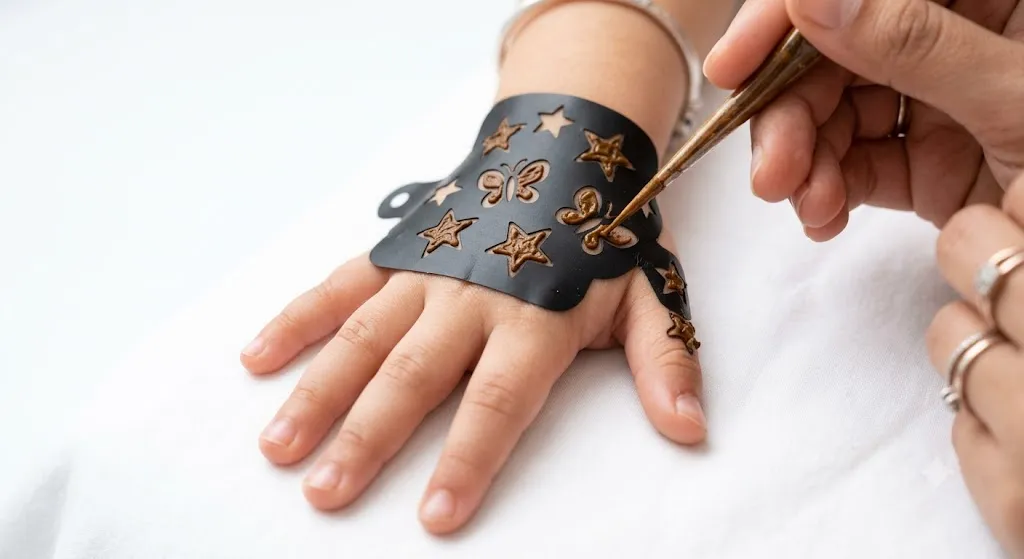
Kids often love the excitement of mehndi during Eid, Diwali, weddings, birthday parties, and family celebrations. The difficulty is that young children may not sit still long enough for a detailed hand-drawn pattern.
Kids’ mehndi stencil designs provide a practical alternative. A parent or caregiver can place a small stencil on the hand, spread mehndi paste over the open areas, and lift it away to reveal a clear pattern. The process is generally faster and easier to control than drawing every flower, star, or butterfly by hand.
The best designs for children are not simply smaller versions of adult bridal patterns. They should match the size of the child’s hand, have bold openings, require a short application time, and remain easy to recognize even if the child moves slightly.
For a broader introduction to stencil styles, materials, and festive applications, read the Mehndi and Festive Stencil Designs Complete Guide.
This guide covers the most suitable motifs, placements, age-appropriate design sizes, application steps, common mistakes, and practical safety considerations for parents.
What are kids’ Mehndi Stencil Designs?
Kids’ mehndi stencil designs are small, pre-cut patterns used to guide the application of henna or mehndi paste on a child’s hand, wrist, arm, or foot.
A stencil may be made from:
- Flexible adhesive material
- Thin reusable plastic
- Transfer stencil material
- Pre-cut sticker sheets
- Printable sheets that are manually cut
- Temporary body-art stencil film
Mehndi itself is a form of temporary skin decoration created with henna paste. Unlike a permanent tattoo, the design stains the outer layer of the skin and fades gradually as the skin naturally exfoliates.
For children, stencil patterns usually feature familiar and playful shapes rather than dense bridal details. Popular examples include flowers, hearts, butterflies, stars, moons, rainbows, leaves, and small mandalas.
Why Are Mehndi Stencils Useful for Children?
Applying mehndi to a child presents different challenges from applying it to an adult. Children may move their fingers, touch the wet paste, become bored, or ask to wash their hands before the design has dried.
A well-chosen stencil helps by making the active application stage shorter.
Main benefits of kids’ mehndi stencils
- Faster than drawing a detailed design by hand
- Easier for parents and beginners to use
- Produces recognizable shapes with fewer drawing skills
- Helps keep repeated designs consistent
- Reduces the chance of uneven flowers or shaky outlines
- Works well for parties with several children
- Makes it easier to select a small, age-appropriate pattern
A stencil does not guarantee a perfect result. Paste thickness, stencil adhesion, hand movement, and removal technique still affect the final design. However, a simple stencil with bold openings is usually more forgiving than a highly detailed pattern.
Best Kids Mehndi Stencil Designs
The best pattern depends on the child’s age, hand size, patience level, and the occasion.
1. Butterfly Mehndi Stencils
Butterflies are among the most popular designs for children because the shape remains easy to recognize without needing many fine details.
A butterfly stencil can include:
- Two bold wings
- A simple body
- Two curved antennae
- Small dots around the wings
- A tiny flower or star beside the butterfly
Best placement: Back of the hand, wrist, or outer forearm.
Practical tip: Choose a butterfly with wide wing sections rather than tiny lace-like openings. Wide shapes are easier to fill and less likely to blur.
2. Small Flower Mehndi Stencils
Flowers work for almost every festive occasion. They can be playful, traditional, or minimal depending on the number and shape of the petals.
Good flower options for kids include:
- Five-petal flower
- Daisy
- Small lotus
- Sunflower-style circle
- Flower with two leaves
- Mini floral vine
Best placement: Center of the back hand, side of the palm, or wrist.
Three or four dots can also surround a single flower to make the design look complete without extending it across the whole hand.
For more flower-based pattern inspiration, see the Floral Mehndi Stencil Ideas collection.
3. Heart Mehndi Stencils
Heart stencils are easy to understand, quick to apply, and suitable for birthdays, school celebrations, weddings, and casual family events.
Possible variations include:
- One outlined heart
- Double-heart pattern
- Heart with dots
- Heart-shaped flower
- Heart bracelet
- Heart with a child’s initial
Best placement: Back of the hand, wrist, or lower forearm.
Avoid filling the entire heart with a thick layer of paste. A bold outline often produces a cleaner and more comfortable design.
4. Star Mehndi Stencils
Stars are particularly useful when several children want mehndi because they can be applied quickly.
Try:
- One large star
- Three-star cluster
- Star and moon combination
- Star trail along one finger
- Star bracelet around the wrist
- Star with small dots
Best placement: Back of the hand, finger side, or wrist.
A cluster of two or three different-sized stars often looks more interesting than one large solid shape.
5. Moon and Crescent Stencils
Crescent moon designs are especially suitable for Eid, Chand Raat, and Ramadan-related gatherings.
A child-friendly moon stencil may contain:
- Simple crescent
- Crescent with one star
- Moon surrounded by dots
- Crescent inside a small circle
- Moon-and-lantern combination
- Smiling moon motif
Best placement: Back of the hand or center of the palm.
Keep additional details limited. A clear crescent and one or two stars usually look better on a small hand than a crowded night-sky scene.
6. Mini Mandala Mehndi Stencils
A mandala can give a traditional mehndi appearance without covering the entire hand.
For children, choose a mandala with:
- One central circle
- Six to eight broad petals
- A dotted outer border
- Limited internal lines
- A diameter that fits comfortably in the palm
Best placement: Palm or back of the hand.
Very detailed adult mandalas may lose clarity on a small hand. Bold petals and open spacing are more suitable for a child-sized stencil.
7. Animal and Bird Stencils
Playful animal motifs can make the activity more engaging for children who are not interested in traditional patterns.
Ideas include:
- Small cat face
- Fish
- Peacock feather
- Tiny bird
- Rabbit outline
- Ladybird
- Elephant
- Dolphin
Best placement: Back of the hand or forearm.
Use a silhouette or simplified outline. Detailed facial features and thin internal lines can be difficult to reproduce with paste.
8. Rainbow and Cloud Designs
Rainbow motifs are suitable for birthday parties and informal celebrations.
A simple stencil may contain:
- Three curved rainbow lines
- One cloud
- Rainbow with dots
- Two clouds connected by an arch
- Rainbow and star combination
Best placement: Back of the hand or outer forearm.
This type of pattern is usually decorative rather than traditional, making it a fun option when a child wants something playful and modern.
9. Bracelet Mehndi Stencils
A bracelet design wraps around the wrist or appears as a decorative band across it.
Child-friendly bracelet patterns include:
- Hearts connected by dots
- Small flowers and leaves
- Stars on a curved line
- Simple scalloped border
- Beaded chain pattern
- Moon-and-star band
Best placement: Wrist.
Bracelet stencils work well for children who do not want paste on their palms or fingers. They are also less likely to interfere with holding snacks, toys, or party items.
10. Name and Initial Stencils
A personalized initial can make the design feel special without requiring a large pattern.
The initial may be combined with:
- A small crown
- One flower
- Two stars
- A heart
- A leafy circle
- A simple border
Best placement: Back of the hand or wrist.
Keep the letter thick and readable. Very thin script fonts may tear during stencil removal or produce incomplete marks.
Which Design Is Best for Different Age Groups?
Age alone does not determine which stencil to use. Hand size, sensitivity, attention span, and the child’s ability to avoid touching the paste are equally important.
The following comparison provides a practical starting point:
Approximate age, Suitable design, Recommended placement, Approximate application complexity
3–5 years One flower, heart, or star Back of hand Very low
5–7 years Butterfly, moon and star, small animal Back of hand or wrist Low
7–10 years Floral trail, bracelet or mini mandala Hand, palm or wrist Low to medium
10–12 years Finger trail, Arabic-style flower or leafy band Back hand, fingers or wrist Medium
Teenagers, larger mandala, Arabic trail or mixed motifs, Palm, hand, wrist or forearm, Medium
These are design recommendations rather than strict age rules. A small motif is generally the easiest choice whenever the child has limited patience.
Best Placements for Kids Mehndi Stencils
Placement affects comfort, visibility, and how easily the design can remain undisturbed.
Back of the Hand
The back of the hand is often the most practical position for children.
It is suitable for:
- Butterflies
- Flowers
- Hearts
- Stars
- Moons
- Small animals
- Mini mandalas
The child can keep the hand relatively open without holding the palm upward for a long period.
Palm
The palm can develop a visually strong design, but it may be more difficult for an active child because the child must avoid closing the hand or touching objects.
Suitable palm designs include:
- Small mandala
- Sun
- Flower
- Moon
- One bold symbol
Avoid a full-palm pattern when the child needs to eat, play, or get dressed soon after application.
Wrist
The wrist is useful for bracelet designs, floral bands, and small symbols.
It can be more comfortable than the palm because the child can still move the fingers. Confirm that the stencil does not wrap so tightly that it pulls or pinches the skin.
Fingers
Finger designs look attractive but require better control. Thin finger stencils can lift around the curved sides, allowing paste to spread beneath the edge.
Start with:
- One dotted line
- Tiny leaves
- One ring band
- A small star near the fingertip
- A simple vine on one finger
Forearm
The forearm provides a flatter surface and is useful for animals, rainbows, names, and larger playful designs.
It may be a better choice for a very young child because the child does not need to keep the fingers completely still.
How to Apply a Kids Mehndi Stencil Step by Step
Before beginning, read the product instructions and identify all ingredients in the paste. Do not use a product simply because its packaging describes it as natural.
For a more detailed general tutorial, visit How to Use Mehndi Stencils at Home.
Step 1: Select a Small Design
Choose one motif that fits within the intended area without bending over knuckles or finger joints.
For a first attempt, use:
- One flower
- One butterfly
- A small moon
- A three-star cluster
- A simple wristband
Avoid full-hand and highly detailed bridal patterns.
Step 2: Check the Skin
Do not apply the stencil or paste over:
- Cuts
- Scratches
- Rashes
- Sunburn
- Blisters
- Irritated skin
- Active eczema patches
If the child has a history of serious skin reactions or a diagnosed medical condition affecting product use, seek guidance from an appropriate healthcare professional.
Step 3: Clean and Dry the Area
Wash the area gently and dry it completely.
Do not apply moisturizer, oil, or heavy cream immediately before placing an adhesive stencil. Oily skin can prevent the stencil from sealing properly.
Step 4: Position the Stencil
Ask the child to rest the hand or arm on a stable surface.
Place the stencil carefully and press around:
- Petal edges
- Star points
- Thin lines
- Inner cutouts
- Curved sections
The stencil must sit flat. Small gaps allow paste to move underneath and blur the pattern.
Step 5: Apply a Thin, Even Layer
Spread the paste across the stencil openings using the applicator recommended for the stencil.
Do not force a large amount of paste into the openings. A thick layer can move below the stencil, join separate sections, and produce uneven edges.
Step 6: Lift the Stencil Carefully
Follow the stencil manufacturer’s timing guidance.
Lift from one side using a slow, controlled movement. Do not drag the stencil sideways across the skin.
If the stencil is reusable, place it on a suitable washable surface before cleaning it according to its material instructions.
Step 7: Keep the Design Undisturbed
Ask the child not to touch the area while the paste is setting.
Helpful distractions include:
- Reading a short story
- Watching a familiar program
- Listening to music
- Taking family photos
- Sitting beside another child receiving mehndi
Avoid using heat devices or unverified home mixtures to accelerate the process.
Important Safety Considerations for Parents
A child-friendly stencil design does not automatically make the paste child-safe. The stencil controls the shape; it does not determine the ingredients being placed on the skin.
Avoid Black Henna and Unknown Fast-Staining Pastes
So-called black henna may contain para-phenylenediamine, commonly abbreviated as PPD. This substance has been associated with allergic contact dermatitis, blistering, and other serious skin reactions. Children as well as adults can be affected.
Do not assume that an unknown paste is safe because:
- It produces a very dark result quickly
- It is sold at a festival or tourist location
- The seller calls it herbal
- The package says temporary
- Other people have used it without an immediate reaction
Natural henna normally develops toward an orange-brown or reddish-brown stain rather than creating an instant jet-black stain.
A small-area test does not make an unidentified black henna product safe. When ingredients are missing, unclear, or suspicious, the safest option is not to apply the product.
Supervise the Entire Process
An adult should control:
- Stencil placement
- Paste application
- Drying
- Removal
- Hand washing after the activity
- Storage of cones and materials
Do not allow a young child to squeeze a cone toward the face, mouth, or eyes.
Stop if Irritation Occurs
Remove the product and seek appropriate medical advice if the child develops symptoms such as:
- Strong burning
- Increasing pain
- Swelling
- Blisters
- Intense itching
- A spreading rash
- Difficulty breathing
Do not reapply the same product after a reaction.
Common Mistakes When Using Kids Mehndi Stencils
Choosing a Stencil That Is Too Large
A design that crosses knuckles, finger joints, or the sides of the hand will not sit flat.
Solution: Measure the intended area and choose one central motif instead of a complete adult hand pattern.
Selecting Too Many Fine Details
Tiny lines may tear, lift, or fill with paste.
Solution: Look for bold outlines, open petals, and clear spacing between shapes.
Applying Too Much Paste
Excess paste can spread beneath the stencil.
Solution: Use a controlled, even layer rather than building a thick mound over the design.
Applying Lotion Before the Stencil
Moisturizer and oil can weaken stencil adhesion.
Solution: Start with clean, dry skin unless the stencil manufacturer provides different instructions.
Removing the Stencil Sideways
Dragging the stencil may smear the design.
Solution: Lift gradually upward from one edge.
Applying Mehndi Immediately Before a Busy Activity
The child may touch clothes, food, furniture, or other people before the design is ready.
Solution: Schedule the application during a calm part of the event.
Expecting a Child to Sit Through a Full-Hand Design
Large designs can turn a fun activity into a frustrating experience.
Solution: Begin with one five-minute motif. Add a second small design only when the child remains comfortable and interested.
Kids Mehndi Stencil Ideas by Occasion
Eid and Chand Raat
Choose:
- Crescent moon
- Stars
- Lantern
- Mini mosque-inspired arch
- Moon bracelet
- Flower-and-crescent combination
A small moon on the back of the hand is quick, festive, and easy to photograph.
Diwali
Try:
- Diya
- Lotus
- Flower rangoli
- Small mandala
- Leaf border
- Decorative dots
Keep flame and petal sections wide enough for a clean stencil result.
Weddings
Suitable patterns include:
- Mini floral trail
- Heart
- Simple mandala
- Bracelet design
- Peacock feather
- Bride-and-groom initials
Children participating in wedding photographs may prefer a back-hand pattern that remains visible while holding flowers or gifts.
Birthday Parties
Fun options include:
- Crown
- Star
- Rainbow
- Butterfly
- Cat
- Initial
- Balloon
- Small flower
For group activities, offer three to five predefined stencils rather than asking every child to choose from a large catalog.
School and Cultural Events
Use simple, culturally relevant designs that can be applied quickly:
- One flower
- Small paisley
- Mini mandala
- Leaf
- Moon
- Geometric border
Confirm that body decoration is permitted under the school or event rules before application.
How Can You Keep a Child Still During Mehndi Application?
The most effective strategy is to reduce the time the child needs to remain still.
Prepare everything before asking the child to sit down:
- Open the stencil package
- Select the exact design
- Clean the work area
- Position tissues nearby
- Prepare the paste
- Choose a drying activity
- Remove bracelets or watches
Let the child choose between two appropriate patterns. Offering a limited choice creates involvement without delaying the activity.
A child who is uncomfortable, anxious, or no longer interested should not be pressured to continue.
Are Reusable or Adhesive Stencils Better for Kids?
Adhesive Stencils
Advantages:
- Stay in place more easily
- Useful for small hands
- Reduce edge movement
- Suitable for beginners
Limitations:
- May pull sensitive skin during removal
- Adhesive strength varies
- Some are intended for one use only
- Can wrinkle on finger joints
Reusable Plastic Stencils
Advantages:
- Can be cleaned and used again
- Useful for parties
- Available in many motif sizes
- Less waste per repeated use
Limitations:
- May move on curved hands
- Usually require an adult to hold them
- Paste can spread beneath raised edges
- Detailed versions can be difficult to clean
For most first-time users, a small flexible adhesive stencil is easier to control. A reusable stencil may be more economical when the same motif will be applied to several children.
People Also Ask
Can Children Use Mehndi Stencils?
Children can use appropriately sized mehndi stencils under adult supervision. The stencil should be comfortable, and the paste ingredients should be clearly identified. Avoid applying products to irritated or broken skin.
What Is the Easiest Mehndi Design for a Child?
A single five-petal flower, butterfly, star, heart, or crescent moon is usually easier than a finger trail or full-hand pattern.
Which Hand Is Better for Kids’ Mehndi?
The back of the hand is often easier because the child does not need to hold the palm open. It also reduces the likelihood of the wet design touching food or objects.
How Big Should a Kid’s Mehndi Stencil Be?
A small motif should fit on a flat section of the hand without crossing knuckles or wrapping around the sides. The exact size depends on the child’s hand rather than age alone.
Are Full-Hand Mehndi Stencils Suitable for Children?
They can be used for older, patient children, but they are usually unnecessary for younger kids. One or two small motifs are faster, more comfortable, and easier to maintain.
Can a Cricut-Made Stencil Be Used on a Child’s Skin?
A cut design should only be used when the stencil material and adhesive are specifically documented as suitable for the intended skin-contact application. Standard craft vinyl should not automatically be treated as body-safe.
Why Did the Design Smudge Under the Stencil?
Common causes include:
- Loose stencil edges
- Oily skin
- Too much paste
- Movement during application
- A pattern crossing a joint
- Sideways stencil removal
Clean and dry the area, choose a flatter placement, and apply a thinner layer next time.
Final Thoughts
The best kids’ mehndi stencil designs are small, bold, and easy to recognize. A child does not need a full-hand bridal pattern to feel included in a celebration. One butterfly, flower, moon, star, or wrist bracelet can create a charming, festive look with much less waiting and mess.
Choose the design according to the child’s hand size and patience, prepare the materials before beginning, apply a controlled layer of paste, and keep the experience relaxed. Most importantly, treat paste selection as a separate safety decision rather than assuming every product sold for temporary body art is appropriate for children.For your next design session, explore Floral Mehndi Stencil Ideas and adapt one bold flower or leafy motif to fit a smaller hand.
References and Learn More
- Wikipedia’s overview of mehndi — Background definition, cultural context and general application information.
- DermNet guide to black henna tattoo reactions — Dermatology information about PPD-related reactions and associated symptoms.
- PubMed case report on black henna contact dermatitis in a child — Academic medical reference explaining that reactions are more commonly associated with PPD-added paste than natural henna.