Calculate your stencil project
Plan repeating wall stencils with exact motif counts, consistent gaps, and centered edge margins.
Enter your values and calculate.
How to use the Stencil Repeat Spacing Calculator
This free stencil repeat spacing calculator helps plan an evenly spaced pattern on a wall, floor, sign, canvas, or other flat surface. Enter usable surface dimensions, one motif's width and height, and your preferred horizontal and vertical gaps. It calculates complete motifs in rows and columns, plus balanced side and top margins. Unlike a stencil sheet yield calculator, it plans the position of painted motifs on a surface, not the number of cutouts from a sheet.
Enter the six layout measurements
- Surface width: Usable horizontal area in inches.
- Surface height: Usable vertical area in inches.
- Motif width: Outer width of one design.
- Motif height: Outer height of one design.
- Horizontal gap: Space between motifs across a row.
- Vertical gap: Space between neighboring rows.
Press Calculate to view columns, rows, motif count, side margins, and top margin. The result updates when inputs change. All six measurements use inches; the formula assumes identical, unrotated rectangular motif bounds in a straight grid.
Stencil repeat spacing formula explained
Calculate columns with floor((surface width + horizontal gap) ÷ (motif width + horizontal gap)). Calculate rows using surface height, motif height, and vertical gap instead. Multiply columns by rows for the complete motif count. Adding one gap to the available dimension corrects for the fact that there is no gap after the final motif. Rounding down prevents counting patterns that would extend past the surface edge.
Occupied row width equals columns × motif width + (columns − 1) × horizontal gap. Subtract that from the surface width and divide by two to find each side margin. Use the corresponding vertical values for top and bottom margins. These are equal-margin layout estimates, not cutting tolerances.
Worked example: 48 × 36 inch wall stencil layout
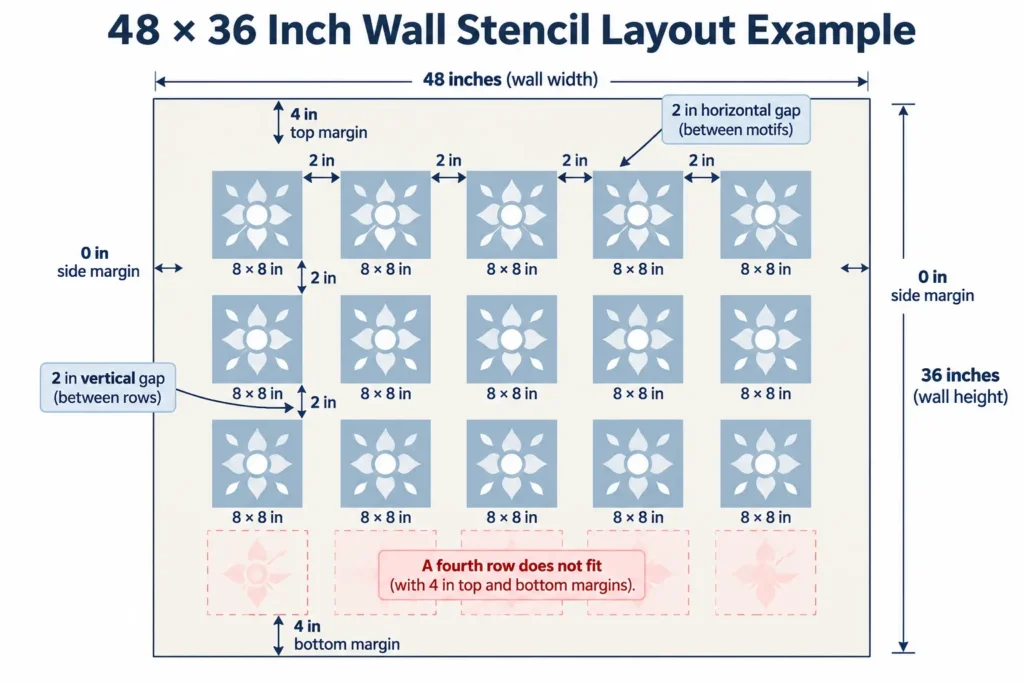
Imagine a 48-inch-wide, 36-inch-high panel. Your motif is 8 × 8 inches, with 2-inch gaps in both directions. Five motifs use 40 inches across, and four gaps use 8 more. Three rows use 24 inches in height, plus two gaps totaling 4 inches. The calculator returns 5 columns × 3 rows = 15 complete motifs. The row fills all 48 inches, so side margins are 0.00 inches. The 28-inch-high arrangement leaves 8 inches vertically, or 4.00 inches at both top and bottom. A fourth row will not fit.
Horizontal and vertical gaps: what changes?
Horizontal spacing is the distance between motifs in one row; vertical spacing separates rows. The values can differ. The distance from the start of one motif to the start of the next is called the repeat pitch: motif width plus horizontal gap, or motif height plus vertical gap. A wider pitch creates more open space but may reduce the number of complete repeats.
How to center a repeated stencil pattern
The output gives a practical starting point for marking a centered grid. Measure the side margin from the left edge and the top margin from the upper edge. Mark the first motif corner, check it with a level, and measure subsequent motif starts using the horizontal and vertical pitch. Confirm multiple positions with removable tape before painting. Small alignment errors can build up when a pattern repeats across a large wall.
Registration marks for repeat wall stencils
Some reusable wall stencils include registration marks to position the next painted repeat. Royal Design Studio explains several methods in its registration marks guide. Stencil Revolution demonstrates aligning stencil repeats horizontally and vertically. Seamless patterns can use zero gap or built-in overlap; follow your stencil's actual marks. This calculator supports nonnegative gaps but does not model overlap between artwork shapes.
Account for corners, doors, and obstacles
Measure the rectangular area genuinely available for full motifs. Windows, doors, sockets, baseboards, and corners can interrupt a row or column. Split the project into separate clear regions when necessary. This tool deliberately counts only full rectangular motif bounds; it does not position partial stencils, staggered rows, half-drop repeats, or rotations. Check the design on paper before marking permanent paint locations.
Repeat spacing versus stencil sheet yield
Use this calculator when you want to know how many wall stencil repeats fit at specific gaps and where centered margins fall. The Stencil Sheet Yield Calculator estimates cutout quantities on Mylar sheets instead. To budget paint for the completed arrangement, use the Stencil Paint Coverage Estimator. For new stencil artwork, try our free online Stencil Maker. Each tool answers a different planning question.
Frequently asked questions
Can I enter a zero-inch gap?
Yes. Zero places rectangular motif bounds edge to edge. It does not automatically join the artwork or align registration marks.
Why are fewer motifs counted than expected?
Only whole motifs are counted. Reducing the motif dimensions or gaps may allow an additional row or column.
Does the calculator center the pattern?
It estimates equal margins on opposite edges for the fitted grid. Obstacles and irregular surfaces require manual adjustments.
Does it support staggered or half-drop patterns?
No. It assumes identical rows and columns. Offset layouts need a separate design plan.
Can I use it for signs or floors?
Yes. The same calculations work for rectangular flat surfaces, provided all dimensions and gaps are measured consistently.