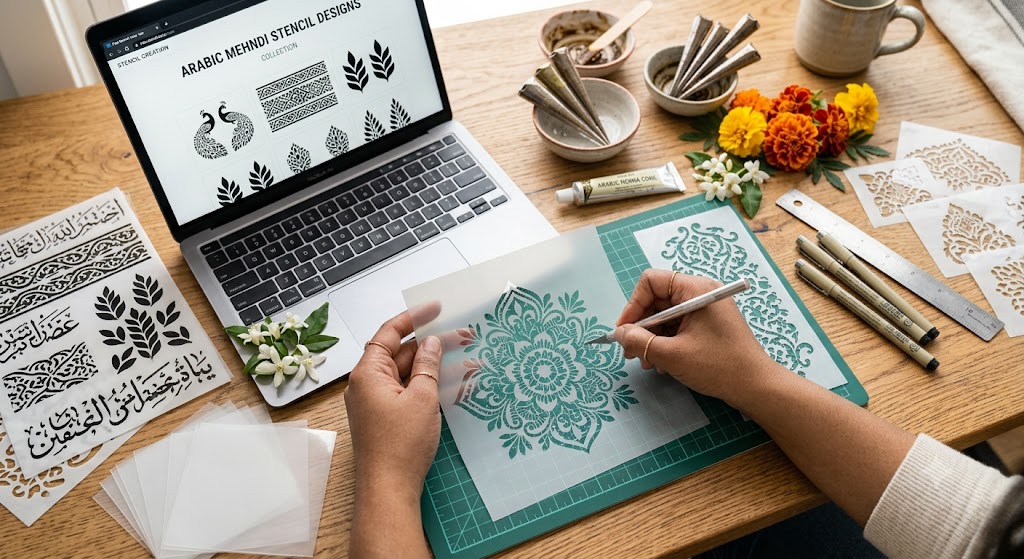
Arabic mehndi stencil designs are perfect for anyone who wants a graceful, stylish, and less crowded mehndi look without spending hours on freehand drawing. Arabic-style mehndi is loved for its flowing lines, floral trails, leafy patterns, open spaces, bold curves, and elegant hand coverage. When these designs are turned into stencils, they become much easier for beginners, busy users, and festive home application.
This article is part of our Mehndi & Festive Stencil Designs Complete Guide. If you are new to stencil application, first read our guide on how to use mehndi stencils at home. For easier patterns, you can also explore simple mehndi stencil designs for beginners.
Unlike very dense full-hand mehndi, Arabic stencil designs usually give a cleaner and more modern look. They often leave natural skin gaps between flowers, vines, paisleys, and finger details. This makes them suitable for Eid, weddings, engagement events, family functions, parties, school celebrations, and quick festive looks.
In this collection, you will find Arabic mehndi stencil ideas for back hands, front hands, fingers, wrists, palms, kids, bridesmaids, and minimal modern looks. You will also learn how to choose the right stencil, where to place it, which designs suit beginners, and what mistakes to avoid.
What Are Arabic Mehndi Stencil Designs?
Arabic mehndi stencil designs are pre-cut or printable patterns inspired by Arabic-style henna flow. These stencils usually include open floral trails, curved vines, paisley shapes, leafy borders, finger lines, wrist bands, and diagonal hand layouts. Instead of drawing the pattern by hand, you place the stencil on the skin and apply mehndi paste through the open design areas.
Henna is a plant-based dye traditionally used for body art and temporary skin staining, and it has a long history across North Africa, the Middle East, and South Asia. Wikipedia notes that henna is made from dried, powdered leaves of Lawsonia inermis and is used to create reddish stains in body art.
Arabic mehndi stencils are useful because they combine the beauty of traditional henna patterns with the convenience of ready-made design templates.
Why Arabic Mehndi Stencils Are Popular
Arabic stencil designs are popular because they are easier to wear, faster to apply, and visually elegant. They do not usually cover every inch of the hand, so the final design looks lighter and more breathable.
Key Reasons People Love Arabic Mehndi Stencils
- They are beginner-friendly.
- They look stylish without being too heavy.
- They work well for both front and back hands.
- They are ideal for Eid and wedding guests.
- They usually dry faster than dense full-hand designs.
- They are easier to match with jewelry and outfits.
- They create a neat look even without freehand skills.
- They can be applied quickly at home.
For users who want beauty without complicated application, Arabic mehndi stencils are one of the best starting points.
Arabic Mehndi Stencil Design Collection
Below is a practical collection of Arabic mehndi stencil styles. Each design type includes the best placement, ideal occasion, and beginner difficulty level.
1. Simple Arabic Floral Trail Stencil
A simple floral trail is one of the most classic Arabic mehndi stencil designs. It usually starts from the wrist or lower side of the hand and moves diagonally toward the index finger or middle finger.
Best Placement
- Back hand
- Side of palm
- Wrist to finger trail
- Front hand diagonal layout
Best For
- Beginners
- Eid
- Casual family events
- Quick home mehndi
- Teen-friendly festive looks
Design Features
- Large flowers
- Curved stems
- Small leaves
- Open spaces
- Light finger detail
This design is perfect because it gives an Arabic look without overwhelming the hand. The open skin gaps make it look elegant and clean.
2. Arabic Back Hand Stencil Design
Back-hand Arabic stencils are among the most requested mehndi stencil styles. They usually look more visible in photos, especially when paired with rings, bangles, nail polish, or festive outfits.
Best Placement
- Full back hand
- Diagonal back-hand trail
- Wrist-to-index-finger layout
- Bracelet and finger combination
Best For
- Eid photos
- Engagement events
- Wedding guests
- Bridesmaids
- Formal festive looks
Design Features
- One large flower near the center
- Leafy vine across the hand
- Finger strips
- Wrist bracelet pattern
- Empty space around the design
Back-hand Arabic stencils are excellent for people who want a graceful look but do not want dense bridal mehndi.
3. Arabic Finger Mehndi Stencil
Finger stencils are small, easy to apply, and useful when you want a minimal mehndi look. They can be used alone or combined with a back-hand stencil.
Best Placement
- Index finger
- Ring finger
- All fingers
- Finger tips
- Finger sides
Best For
- Minimal mehndi
- Modern looks
- Office-friendly festive style
- Quick party application
- Young girls and beginners
Design Features
- Thin lines
- Dots
- Mini leaves
- Small flowers
- Ring-style bands
- Fingertip filling
Finger stencil designs look best when they are not overloaded. A few clean lines and small motifs are enough to create an elegant effect.
4. Arabic Wrist Bracelet Stencil
A wrist bracelet stencil creates the look of mehndi jewelry. It can be used alone or connected to a floral trail on the hand.
Best Placement
- Wrist
- Lower palm
- Back-hand wrist area
- Around the arm like a bangle
Best For
- Party looks
- Eid outfits
- Wedding guests
- Bridesmaids
- Matching jewelry styles
Design Features
- Bangle-style borders
- Chain patterns
- Small floral drops
- Leaf bands
- Curved bracelet lines
This stencil style is especially useful when you want a simple but complete look. It pairs beautifully with bangles, watches, and bracelets.
5. Arabic Palm Stencil Design
Arabic palm stencils are less dense than traditional full-palm mehndi. They often use a floral center, paisley curve, or half-mandala connected to finger lines.
Best Placement
- Center palm
- Side palm
- Palm-to-finger flow
- Lower palm
Best For
- Traditional festive looks
- Eid
- Family functions
- Simple wedding mehndi
- Beginner palm application
Design Features
- Central floral motif
- Paisley curve
- Leaf trail
- Open palm gaps
- Finger extensions
Palm stencils can be harder to place than back-hand designs because the palm has more movement. Keep the hand flat while applying and drying.
6. Arabic Tikki Stencil With Floral Extension
A tikki stencil usually has a round center motif, but the Arabic version adds floral trails, leafy curves, and finger extensions to make it more stylish.
Best Placement
- Palm center
- Back hand center
- Lower palm
- Around wrist and fingers
Best For
- Eid
- Traditional looks
- Family events
- Girls who like classic mehndi
- Beginner-friendly festive designs
Design Features
- Round center shape
- Floral extension
- Finger detailing
- Dots and leaves
- Open spaces
This is a good option for users who want a mix of traditional tikki and modern Arabic flow.
7. Arabic Bridal-Inspired Stencil
Arabic bridal-inspired stencils are more detailed than beginner designs but still less crowded than full Indian bridal mehndi. They usually include large flowers, paisleys, shaded leaves, and flowing patterns.
Best Placement
- Full back hand
- Front hand
- Wrist to mid-arm
- Feet and ankles
Best For
- Bridesmaids
- Engagement brides
- Nikkah events
- Wedding guests
- Light bridal looks
Design Features
- Bold flowers
- Paisley curves
- Leaf clusters
- Finger coverage
- Wrist bands
- Longer diagonal flow
This design type is best for people who want a special-occasion look without committing to very heavy bridal mehndi.
8. Minimal Arabic Mehndi Stencil
Minimal Arabic stencils are modern, clean, and stylish. They use fewer elements but rely on good spacing and neat placement.
Best Placement
- One finger
- Side hand
- Wrist
- Back-hand corner
- Small palm section
Best For
- Everyday style
- Office parties
- College events
- Simple Eid looks
- Users who dislike heavy mehndi
Design Features
- Thin vines
- Small flowers
- Tiny dots
- Negative space
- Single-line flow
Minimal Arabic stencils are ideal for users who want mehndi that looks fashionable and subtle.
9. Arabic Foot Mehndi Stencil
Foot mehndi stencils are popular for weddings and festive events. Arabic foot designs usually include anklet-style patterns, toe details, floral side trails, and curved vines.
Best Placement
- Side foot
- Anklet area
- Toes
- Top of foot
- Heel-side floral trail
Best For
- Weddings
- Eid
- Bridesmaids
- Engagement events
- Traditional photoshoots
Design Features
- Anklet bands
- Toe lines
- Side floral trails
- Leafy curves
- Open spaces
Foot stencils need extra care because the skin may be curved and the stencil can lift from the edges. Cut the stencil into smaller sections for easier placement.
10. Kids’ Arabic Mehndi Stencil Designs
Kids usually need simple, small, and quick-drying stencil designs. Avoid dense patterns that take too long to dry.
Best Placement
- Small back-hand motif
- Wrist bracelet
- Tiny flower
- Small palm tikki
- One-finger design
Best For
- Eid
- School functions
- Family gatherings
- Birthday parties
- Quick festive fun
Design Features
- Small flowers
- Hearts
- Stars
- Tiny vines
- Simple wrist bands
Always use safe, gentle, natural-looking henna products and avoid strong chemical-smelling cones.
How to Choose the Best Arabic Mehndi Stencil
Choosing the right stencil depends on your hand size, occasion, design preference, and skill level.
For Beginners
Choose:
- Simple floral trails
- Wrist bracelet stencils
- Finger strip stencils
- Small back-hand motifs
- Tikki with floral extension
Avoid:
- Very tiny details
- Full bridal stencils
- Thin lace-like patterns
- Stencils with many disconnected pieces
For Eid
Choose:
- Back-hand Arabic stencil
- Floral diagonal design
- Bracelet and finger combination
- Tikki with finger details
- Crescent-inspired floral layout
For more festive design ideas, read our Eid mehndi stencil designs for hands guide.
For Weddings
Choose:
- Bridal-inspired Arabic stencil
- Wrist-to-arm floral trail
- Back-hand full stencil
- Foot and anklet stencil
- Paisley floral design
For Minimal Looks
Choose:
- One-finger stencil
- Side-hand floral trail
- Small wrist bracelet
- Tiny flower cluster
- Negative-space Arabic pattern
Step-by-Step: How to Apply Arabic Mehndi Stencils
Arabic stencils are easy to use, but the final result depends on careful placement and drying.
Step 1: Clean the Skin
Wash your hand with mild soap and dry it fully. Do not apply lotion, oil, perfume, or cream before the stencil.
Step 2: Cut the Stencil
If the stencil is large, cut it into sections. For example, separate the wrist band, finger strips, and main hand motif.
Step 3: Place the Stencil
Peel the stencil carefully and place it on the skin. Press from the center outward to remove air bubbles.
Step 4: Apply Mehndi Paste
Apply a thin and even layer of mehndi paste over the open stencil areas. Do not apply too much paste because it may bleed under the stencil.
Step 5: Let It Dry
Wait until the paste is semi-dry and stable. Do not move the hand too much during drying.
Step 6: Remove Slowly
Peel the stencil slowly from one corner. Do not pull quickly because the wet paste may smear.
Step 7: Let the Stain Develop
Avoid washing immediately. Let the paste stay as long as possible, then scrape it off gently when dry.
The FDA has reported adverse reactions to some temporary tattoos, henna/mehndi, and black henna products, and notes that some “black henna” products may contain PPD, which can cause dangerous skin reactions in some people.
Common Mistakes With Arabic Mehndi Stencils
Mistake 1: Choosing Too Detailed a Stencil
Arabic designs look simple from far away, but some stencil versions have very small cuts. Beginners should start with bold floral designs.
Mistake 2: Applying Too Much Mehndi Paste
Too much paste can spread under the stencil and blur the lines. Use a thin, controlled layer.
Mistake 3: Removing the Stencil Too Early
Wet mehndi smears easily. Wait until the paste is slightly dry before removing the stencil.
Mistake 4: Not Pressing the Edges
Loose stencil edges cause bleeding. Press the stencil gently before applying paste.
Mistake 5: Washing Too Soon
Washing right after application can reduce stain depth. Scrape dried paste instead of washing immediately.
Mistake 6: Using Unsafe Black Henna
Avoid “instant black” henna products. Natural mehndi usually develops gradually and does not need harsh chemical shortcuts.
Problem-Solution Guide
Problem: The Design Looks Blurry
Cause: Too much paste or loose stencil edges.
Solution: Use less paste and press the stencil edges properly.
Problem: The Stencil Does Not Stick
Cause: Oily or damp skin.
Solution: Wash and dry the skin again before placing the stencil.
Problem: Finger Lines Look Uneven
Cause: Finger stencil shifted during application.
Solution: Apply finger strips separately and keep the fingers still.
Problem: The Design Looks Too Empty
Cause: You selected a very minimal Arabic stencil.
Solution: Add a wrist bracelet or finger strip stencil to complete the look.
Problem: The Stain Is Too Light
Cause: Paste removed too quickly or washed too early.
Solution: Keep the paste longer and avoid water after scraping.
People Also Ask
Are Arabic mehndi stencil designs good for beginners?
Yes. Arabic mehndi stencil designs are very beginner-friendly because they usually have open spaces, larger motifs, and flowing patterns. Simple floral trails and wrist bracelet stencils are especially easy to apply.
Which Arabic stencil design is best for Eid?
The best Arabic stencil design for Eid is a back-hand floral trail with finger details or a tikki-style design with Arabic floral extensions. These designs look festive but are still easy to apply at home.
Can Arabic mehndi stencils be used on both hands?
Yes. Many stencil sheets include mirrored or repeatable patterns. If your stencil is not mirrored, choose flexible floral trails that can still look natural on both hands.
Do Arabic mehndi stencils look natural?
They can look natural when the stencil is placed carefully and the paste is applied evenly. Choose designs with balanced spacing, clean curves, and not too many tiny details.
Are Arabic stencils better than full-hand mehndi?
Arabic stencils are better if you want a lighter, faster, and more modern look. Full-hand mehndi is better for heavy bridal or traditional designs.
Can I use Arabic mehndi stencils for weddings?
Yes. Bridal-inspired Arabic stencils, wrist-to-arm floral trails, and back-hand paisley stencils are beautiful options for weddings, engagement events, and bridesmaids.
Real-World Use Cases
Eid Morning Quick Look
Use a back-hand Arabic stencil with finger strips. It gives a complete festive look without taking too much time.
Wedding Guest Style
Choose a floral-paisley Arabic stencil that covers the back hand and wrist. Pair it with rings and bangles for a photo-ready look.
Bridesmaid Mehndi
Use matching wrist-to-finger Arabic stencils for all bridesmaids. This keeps the group look coordinated without needing long appointments.
Minimal College or Office Look
Choose a one-finger Arabic stencil or small wrist bracelet stencil. It looks stylish without feeling too heavy.
Home Practice for Beginners
Start with simple floral Arabic stencils before trying full-hand or bridal-inspired patterns. This helps you learn spacing, paste control, and stencil removal.
Best Arabic Mehndi Stencil Combinations
Combination 1: Floral Trail + Finger Strips
Best for Eid, parties, and quick festive looks.
Combination 2: Tikki Center + Arabic Wrist Band
Best for traditional family events and simple palm designs.
Combination 3: Back-Hand Flower + Bracelet Stencil
Best for wedding guests and bridesmaids.
Combination 4: Minimal Finger Design + Tiny Wrist Motif
Best for modern, subtle, and office-friendly looks.
Combination 5: Foot Anklet Stencil + Toe Details
Best for weddings, engagement events, and festive photoshoots.
Final Tips for a Clean Arabic Mehndi Stencil Look
- Use clean and dry skin.
- Start with a bold, simple stencil.
- Cut large stencils into smaller sections.
- Press all edges before applying paste.
- Apply a thin layer of mehndi.
- Let paste dry before removal.
- Peel the stencil slowly.
- Avoid water after application.
- Do not use black henna without checking safety.
- Practice once before an important event.
Conclusion
Arabic mehndi stencil designs are a beautiful choice for anyone who wants elegant, flowing, and beginner-friendly mehndi at home. They are perfect for Eid, weddings, family functions, bridesmaids, and modern minimal looks. From simple floral trails to back-hand stencils, wrist bracelets, finger strips, palm motifs, and foot designs, Arabic stencil patterns offer a wide range of styles without requiring advanced freehand skills.
For the best result, choose a stencil that matches your skill level and occasion. Keep the skin clean, apply paste lightly, let it dry properly, and remove the stencil slowly. To continue learning, visit our Mehndi & Festive Stencil Designs Complete Guide, read how to use mehndi stencils at home, and explore simple mehndi stencil designs for beginners.
Learn More / References
1 thought on “Arabic Mehndi Stencil Designs Collection:(Elegant Floral, Back Hand, Finger & Festive Ideas)”